Sind Fische tatsächlich dumm? Oder halten die Menschen sie nur dafür? Fische gelten gemeinhin als stumme, ausdruckslose Wesen ohne Gedächtnis, Gefühle oder sogar ohne Schmerzempfinden. Dabei entdeckt die Wissenschaft immer neue, erstaunliche Eigenschaften und Fähigkeiten der Wasserbewohner.
So verfügen sie anscheinend über ein reges Sozialleben, große Anpassungsfähigkeit und echte Emotionen. „Fische – Schlauer als gedacht?“ ist eine humorvolle und lehrreiche Entdeckungsreise durch die wundersame Wasserwelt, vom Goldfischglas im Wohnzimmer über exotische Korallenriffe bis in die türkisblauen Lagunen von Moorea. Die Dokumentation hinterfragt dabei auch ganz allgemein das Verhältnis des Menschen zur Intelligenz der Tiere.
08/15/2023 – Here’s a little update on my low-maintenance aquarium projects. Over the weekend I threw away two buckets of Vallisneria plants. Thus, the small 60’s baby pool and the DeepSand 350’s pool thinned out. I also cleaned the pumps.
The viewer will notice that everything is so quiet. No, I did not turn off the sound of the video. I use almost no technology. Only lighting and small pumps. And I turn them off together overnight. Thus, the method is considered „LowTech“.
My Lowtech Tanks
I basically use „DeepSoil“ combined with „Walstad“. I use peat instead of simple potting soil. This because I am convinced that the tannins in peat have an antibacterial effect and that is perfect for the health of living beings. And secondly, the fertilizing effect of the peat has a more positive effect on the plants than artificial fertilization due to the slow decomposition over a longer period of time.
The peat is in the middle of the „substrate“, which consists of simple sandbox sand. Only with the 125 Tank did I use dark, fine-grained split for testing.
But I would generally recommend sand, because then the roots grow deeper and finer faster. It is also easier for the malaysian trumpet snails to dig up the sand and convert waste into nutrients than with gravel or grit, the grains of which are larger and heavier.
The planting in the tanks is a mixture of slow-growing and fast-growing plants.
The use of Duckweed has turned out to be important. Duckweed growth is an indicator of the amount of nutrients in the tank. If there is a lot of duckweed in a tank, then there are not enough fast-growing plants. If the duckweed develops negatively, i.e. does not reproduce, then the proportion of plants in the tank is optimal. The Plants absorb all the nutrients and there is nothing left for duckweed.
As fast-growing plants I use Vallisneria, Hydrophilia (water lover) and Hornwort (featherwort). In addition, there is tiger lotus, which blooms one after the other in the „WhiteSandsTank“ every week. In addition, Cryptocoryne in all possible variants.
In the small baby Tank, the small Cryptocoryne variant develops excellently due to the shallow water depth. Chrismasmoss serves to protect youngsters fish on the ground below and the small bacopa (Bacopa monnerie) on top, which constantly blooms purple above the surface.
On the subject of snails. I don’t really understand the hysteria that often prevails here. Snails are important components in the aquarium ecosystem. The system does not work without snails.
In short: snails eat the garbage and the algae in the aquarium excrete nutrients. Bladder snails and ramshorn snails tend to the cleaning troop above the ground. And in the ground, malaysian trumpet snails dig through the sand and eat dead plant parts and other biological garbage. Fertilizer for the plants comes out of the snails at the back. As we all know compared with earthworms.
So, if we know now about Snails that they eat all the garbage and the amout of snails is direct proportional to the food for them: If you have a „snail explosion“ in your tank the solution is NOT to buy a Fish to kill them. The solution is to stop putting in Food that gets garbage, because the fish cannot eat all of it.
I’ve never done water tests. But once and then Mam laughed at me about what I want to do with the chemistry kit. Our family has been in aquaristics for over 50 years. Except that I’m not a „technology junkie“ like my dad, but work according to the „natural aquarium“ method.
There are many natural signs of bad water. For example, when the malaysian trumpet snails on the glass move to the surface at night when the pump is switched off. Then there is not enough oxygen in the tank below. Something is wrong. The pump is clogged. Or it just needs a water change.
Ah, the subject of water changes. In my tank or in my method (DeepSoil&Walstad&LowTech) it only needs a water change every 3-6 months. In my opinion, frequent water changes destroy the biological balance in the tank. This is additional stress for the fish. It takes days for the balance to be restored. Totally unnecessary.
Any noise in the Tank is just as unnecessary. Constant noise stresses living beings, makes them more susceptible to diseases and has a negative effect on life expectancy.
That’s why there is no need for a „bubbler“ in the aquarium. The original argument for a bubbler is „more oxygen“. But if you use my method with „many plants“ they produce enough oxygen. In addition, a lack of oxygen is assimilated (transferred) via the water surface depending on the water temperature. Bubblers are completely unnecessary.
Everything that is made of plastic does not need it in the aquarium either. No plastic plants and no plastic decoration. What is not good in nature is not needed in the aquarium either.
Pebbles are used as decoration. Please no limestones. In my opinion, wood is also very important. Wood is used by catfish for digestion. They also like to grate bacteria and fresh algae off the wood. The wood stabilizes the water quality and serves due to its fine pores as a habitat for useful nitrite bacteria.
Nitrite bacteria convert (poisonous) nitrite into nitrate. Nitrite is an intermediate in the aquarium’s nitrogen cycle. That’s why you have to let a new aquarium run without fish for at least 6 weeks. Nitrite bacteria live everywhere in the aquarium, on stones, on plants, a lot in the wood, a lot in the substrate on the ground and a lot in the filter.
Thus, a large external filter not only brings a lot of filter performance, but also a large amount of nitrite bacteria. However, this carries the risk that in the event of a power failure or other filter failure, the nitrite that then accumulates in the tank will poison the creatures and fish. That’s why I use the method without a filter. My nitrite bacteria all live in the tank. There is no risk of filter failure and of nitrite killing my fish during power failure.
Why I don’t need a filter? Now this could get a bit complicated. I try it:
I feed the fish
The fish therefore have excretions
The excretions and leftover food are converted by the snails into nutrients for the plants.
The nutrients ensure good healthy plant growth. Especially with fast-growing plants.
I regularly take plant material from the aquarium
In addition, all nitrite bacteria are in my aquariums. So there is no reason to use a filter in my aquarium.
So what are my tips for beginners?
Never trust the aquarium industry
Don’t spend too much money on unnecessary clutter.
Don’t buy plastic
Don’t buy special substrates.
Don’t buy expensive lighting.
Don’t buy a big filter.
An easy-to-maintain aquarium needs
A glass basin 2a. Sand as soil substrate at least 6 cm. Better more. 2b. If you want to do the Walstad method: 3cm sand / 1cm peat / 3cm sand
A few pebbles. No limestone (vinegar test)
Wood for the catfish and for stable water quality.
A few slow-growing plants for the foreground
Lots of fast-growing plants for the background.
A small motorized pump.
If you absolutely want to have a filter: A small motorized internal filter.
A simple lighting. (color daylight)
A simple timer for lights and pump/filter
Bladder and ramshorn snails, as well as tower snails as garbage collectors and cleaning crews and fertilizer producers
Easy to keep fish.
If you work like i recommend, you will have never a problem with cloudy (caused by Bacteria) or green (caused by green algea) water. Because the fast growing plants will always win the race for the nutrients.
So you will have fun with the aquaristic for a long time. From the Beginning.
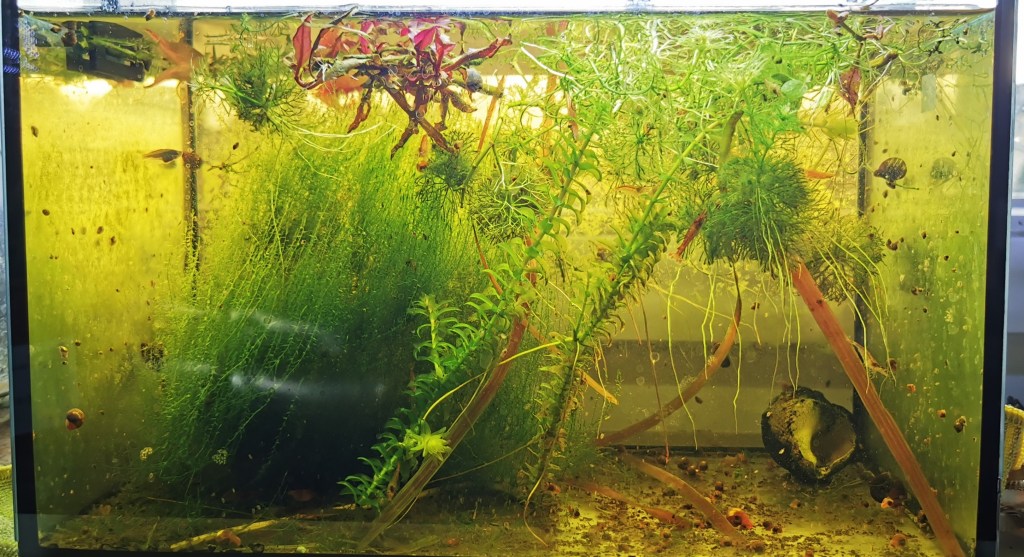
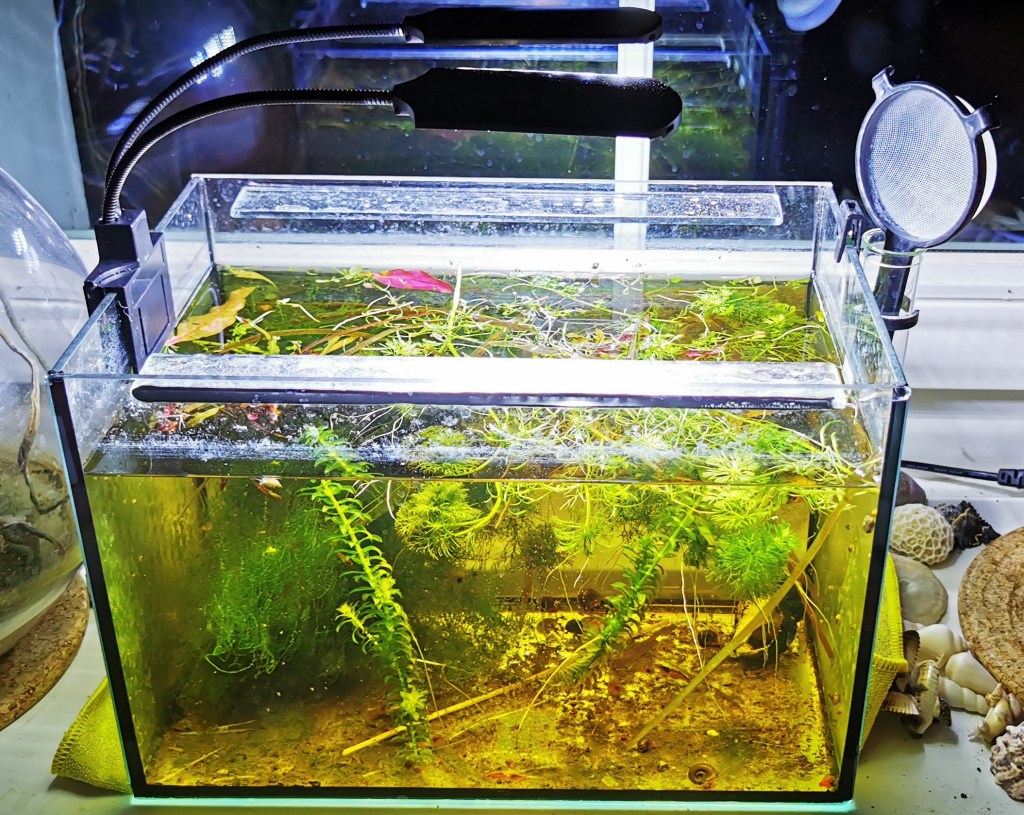
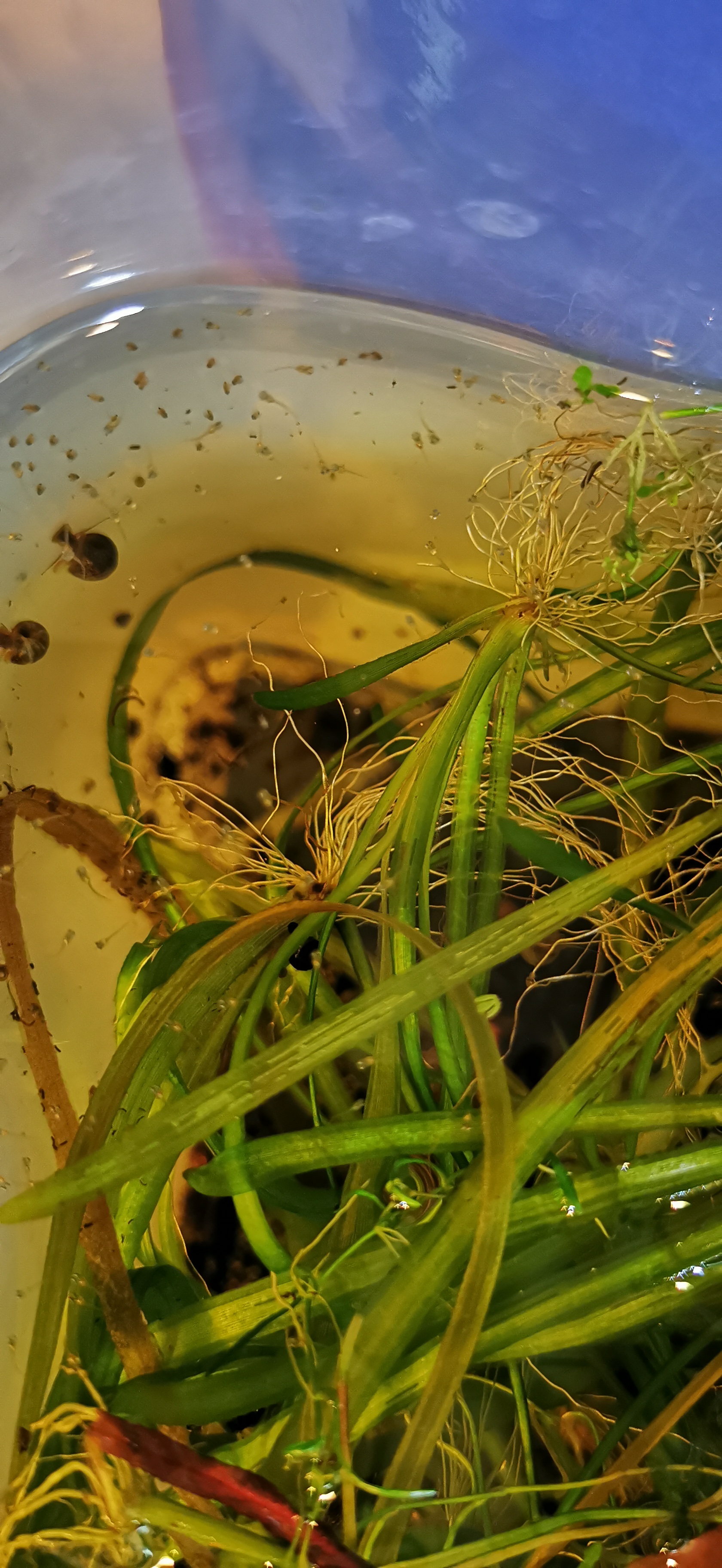
Dieses kleine 12 Liter Becken war ursprünglich für die Zucht von Wasserflöhe gedacht. Deshalb steht es direkt am Fenster, damit sich genügend Algen bilden können. Es besitzt auch keinen Bodengrund.
Der 2,4 Liter „I-Don’t-Care-Tank“
Als ich dann Paradiesfischnachwuchs bekam, setzte ich einen kleinen Wurf da hinein. Einer hat sich unglaublich schnell entwickelt. Die anderen verstecken sich. Damit sich diese verstecken können, gab es etwas Moos und Pflanzen. Von einem Kollegen bekam ich ein paar Red Fire Garnelen und diese setzte ich auch in dieses kleine Becken. Nun läuft das kleine Aquarium ohne jegliche Technik bereits seit 2 Monaten. Ich muss mich darum gar nicht kümmern. Es läuft von selbst. Die Wasserflöhe vermehren sich. Diese fressen die kleinen Paradiesfische. Aber nur soviel bis sie satt sind. Die grossen Daphnien sind eben zu gross und sind zur Daphnienzucht da.
So sieht das kleine Ökosystem aus.
Ausserdem hat es noch Rädertierchen, die man ab und zu rumschwimmen sieht. Und viele Schnecken. Sie weiden die Algen Teppiche von den drei Scheiben ab. Eine davon habe ich sauber gemacht, um hineinschauen zu können. Den Schecken scheint es gut zu gehen.
Die Garnelen fressen die Algen von den Pflanzen und fressen Pflanzenreste. Sollten sie Nachwuchs bekommen, so dient ein Teil davon als Paradiesfisch Futter. Da sie sich aber im dichten Moos verstecken können, sind Überlebenschancen gegeben.
Das Wasser gewechselt habe ich übrigens nie. Auch hab ich den Boden nie abgesaugt. Ganz im Gegenteil, denn erstens verwerten die Schnecken und Garnelen alles biologisch Verwertbare und zweitens bilden sich darin wieder Bakterien, die dann die Pantoffeltierchen und Wasserflöhe ernähren.
Ein guter Indikator für gute Wasserqualität ist der Geruch des Wassers. Riecht man nichts – ist alles gut. Und natürlich die gleichbleibende oder anwachsende Population der Bewohner. Somit hat sich ein kleines Ökosystem gebildet, um das ich mich nicht kümmern muss.
English Translation *Das gilt für bepflanzte Aquarien / Valid for planted Tanks
Wie man hier im Blog mitverfolgen kann, bin ich verfechter der „techniklosen“ bzw. „technikarme“ Aquarien. Dies erreiche ich durch die Kombination von zwei Methoden/Philosophien:
A) Walstad Methode: Verwenden von schnellwachsenden Pflanzen, um Nitrat und Ammoniak, sowie eventuell vorhandenes Phosphat in Wachstum umzuwandeln. Ausserdem verwendet Diana Walstad normale Blumenerde und deckt diese mit Sand oder feinen Kies ab. Ich verwende eine Schichtung aus Sand und Torf. B) Deep Soil Methode: Durch ein relativ hohen Bodengrund wird auf der einen Seite die Denitrifikation im Becken selbst (und nicht im Filter) erledigt. Auch wenn sich viele Aquarienpflanzen überwiegend über das Wasser mit CO2 und Nährstoffen versorgen, so bildet ein hohes Substrat die Grundlage für gesundes Wachstum, weil die tiefer und vielgliedriger ausgebildeten Wurzeln viel mehr Nährstoffe aufnehmen können.
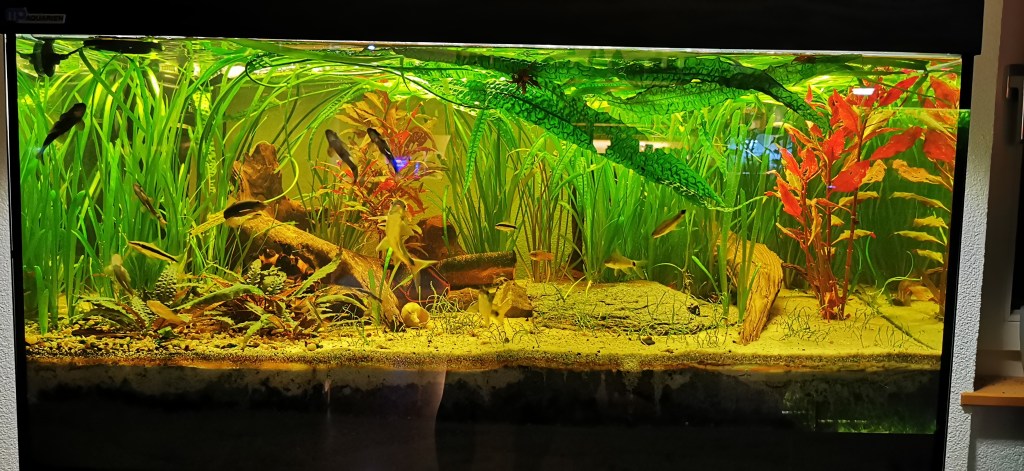
„WhiteSandsTank“ 250 Litre Start 10.10.2020
10 Punkte warum man in Aquarien keine externe Filter benutzen sollte (gültig für bepflanzte Becken)
Die Stickstoff-Bakterien befinden sich im Aquarium.
Das Aquarium läuft stabil
Stromausfall? Kein Problem. Das Aquarium ist in Balance.
Das Ecosystem wird nicht bei jeder Reinigung durcheinander gebracht.
Keine Gefahr des Umkippens der Wasserqualität durch verstopften Filter oder Ansaugrohr mehr.
Keine Leckagen mehr.
Keine Reinigung des externen Filters mehr.
Keine monatliche Schweinerei.
Keine Schläuche und Kabel um den Tank.
Kein Lärm von plätschernden Wasser oder laufenden Motoren
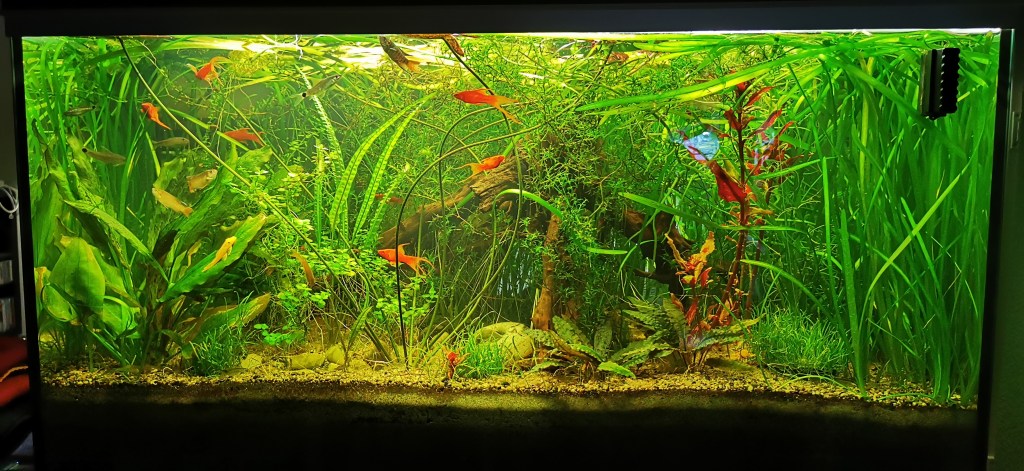
„DeepSoilTank“ 240 Litre Start 28.08.2020
As you can see here in the blog, I am an advocate of „technology-free“ or „technology poor“ aquariums. I achieve this by combining two methods / philosophies:
A) Walstad Method: Use of fast-growing plants to convert nitrate and ammonia, as well as any phosphate that may be present, into growth. Diana Walstad also uses normal potting soil and covers it with sand or fine gravel. I use a layer of sand and peat. B) Deep Soil Method: Due to a relatively high substrate, denitrification is done in the basin itself (and not in the filter) on the one hand. Even if many aquarium plants get their CO2 and nutrients mainly from the water, a high substrate forms the basis for healthy growth because the deeper and more complex roots can absorb much more nutrients.
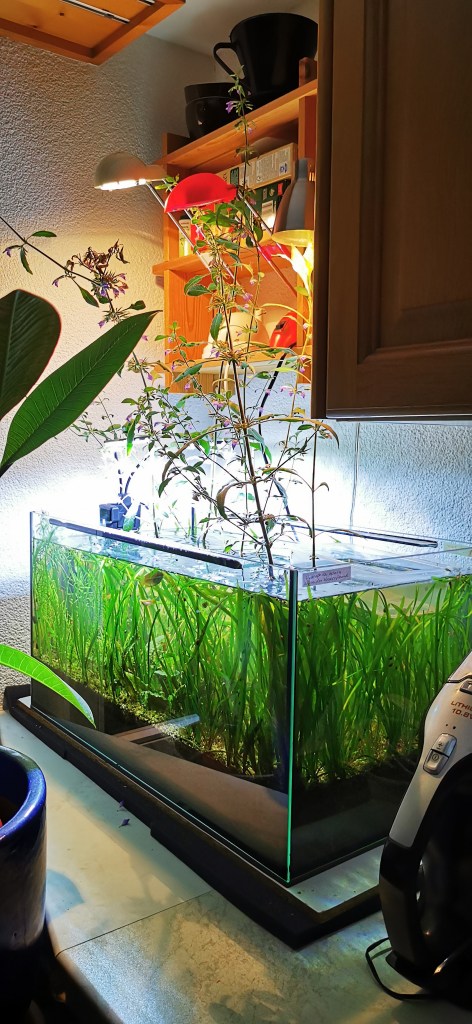
„FensterbankBecken“ 54 Litre Start 07.07.2020
10 points why you shouldn’t use external filters in aquariums (valid for planted tanks)
The nitrogen bacteria are in the aquarium.
The aquarium runs stably
Power failure? No problem. The aquarium is in balance.
The ecosystem is not messed up with every cleaning.
No more risk of the water quality tipping over due to clogged filters or suction pipes.
Wie ziehe ich Nachkommen von Macropodus Opercularis auf? Völlig technisch frei? OK, das ist ein gewöhnlicher Plastikbehälter. Darin deponiere ich Pflanzen, die ich gerade nicht brauche. Er steht am Fenster zusammen mit den überwinternden Frangipani Plumeria.
Ich habe mich seit Oktober nicht mehr um die Pflanzen gekümmert. Es gibt verschiedene Schnecken darin. Diese reinigen die Pflanzen und kümmern sich um tote Pflanzenteile. Keine Technik drin. So bilden sich seit Wochen Infusorien.
Als die Macropodus Opercularis im „DeepSoilTank“ Nachwuchs bekamen und nach etwa 4 Tagen die Babies frei schwammen, fischte ich sie aus dem Aquarium und gab sie in den Plastikbehälter.
In der ersten Woche ernähren sie sich immer noch vom Eidotter. Dann essen sie Infusorien. Seit einer Woche erhalten sie einmal täglich frisch geschlüpfte Artemia.
Je überwachsener und wilder der Tank ist, desto besser funktioniert die Aufzucht. Es braucht keinen Filter oder spezielles Licht. Genieße das video. 😎
Da ich ein paar Anfragen bekommen habe, wie es denn mit meinen Lowtech Becken läuft, habe ich gestern ein kleines Video mit Kommentaren aufgenommen.
Via Facebook Market wurden 3 Schleierschwanz Albino Antennenwelse angeboten. Diese holte ich am Nachmittag ab. Im Video sieht man am Anfang, wie ich diese ins 240 Liter „HighSoilTank“ einsetze.
Alle drei Becken sind Lowtech und auf geringe bzw. gar keine Wasserwechsel konzipiert. Das heisst, dass die Becken nur Licht und eine kleine Pumpe besitzen. Sonst nichts.
Die geringen Wasserwechselraten bekommt man mit der kombinierten „Walstad Methode“, die auf reichlich bepflanzte Becken mit Pflanzenerde mit einer Schicht Sand als Substrat basiert. Ich ergänze das noch mit „DeepSoil“, was hohes Substrat bedeutet. Im hohen Substrat soll der Denitrifikationsprozess ablaufen und für extrem guten Pflanzenwuchs sorgen. Letzteres nimmt dann die für Lebewesen im Übermaß schädlichen Stoffe Nitrat und Ammoniak durch gesundes Pflanzenwachstum aus dem Wasser.
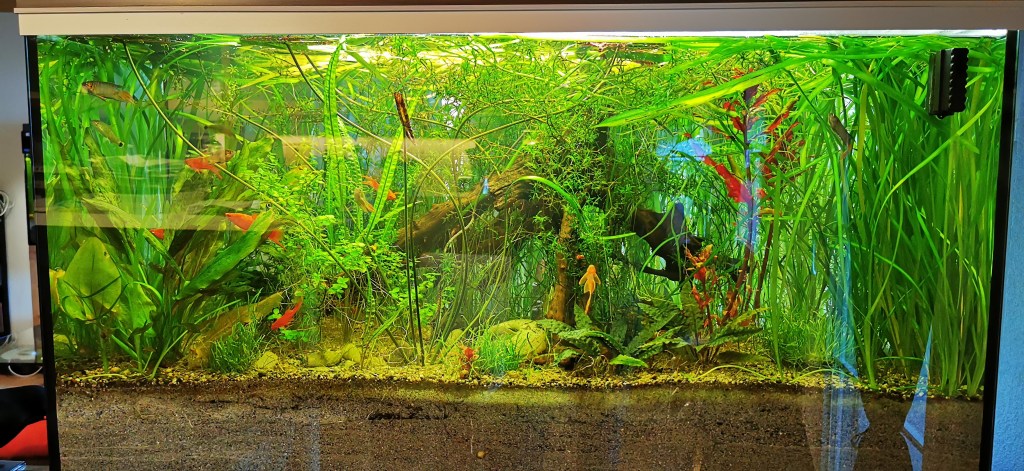
Das „DeepSoilTank“ Becken 240 Liter Lowtech Walstad DeepSoil
Am 28.08.2020 startete das 240 Liter „DeepSoilTank“. Seit etwa 4 Wochen gibt es regelmäßig Nachwuchs bei den Paradiesfischen. Diese versuche ich mehr oder weniger erfolgreich in Aufzuchtbecken zu pflegen. Mittlerweile habe ich sogar mit der Artemiazucht angefangen. Die frisch geschlüpfen Nauplien dienen dann als Aufzuchtfutter. Das ganze ist eine ziemliche Wasserpantscherei. Ausserdem scheinen die ganz kleinen Fische die Nauplien nicht fressen zu können.
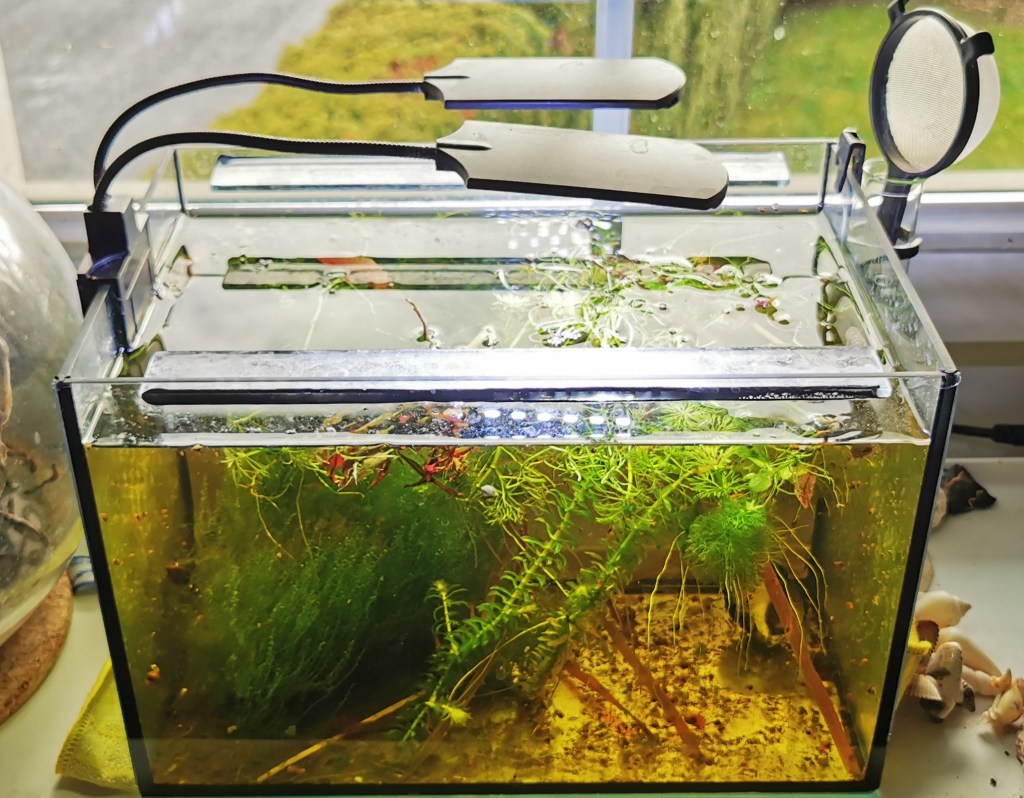
Das „FensterbankBecken“ 54 Liter Lowtech Walstad DeepSoil
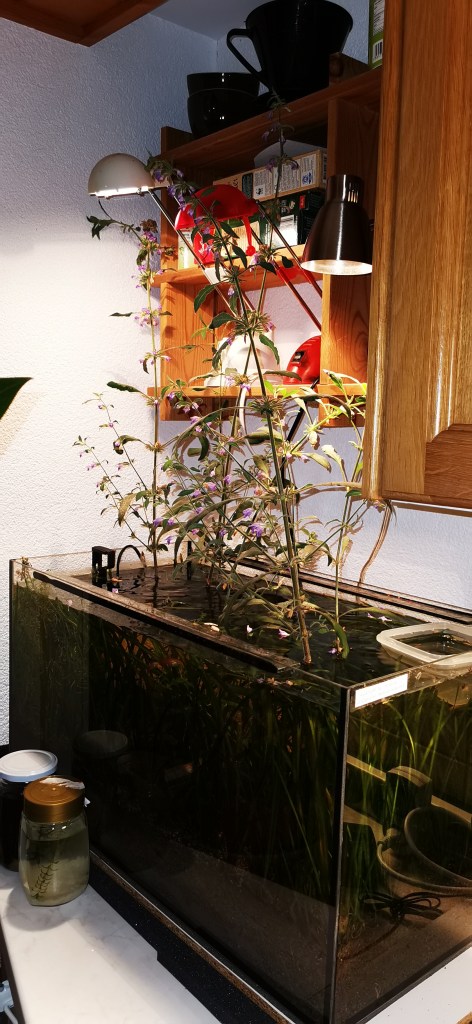
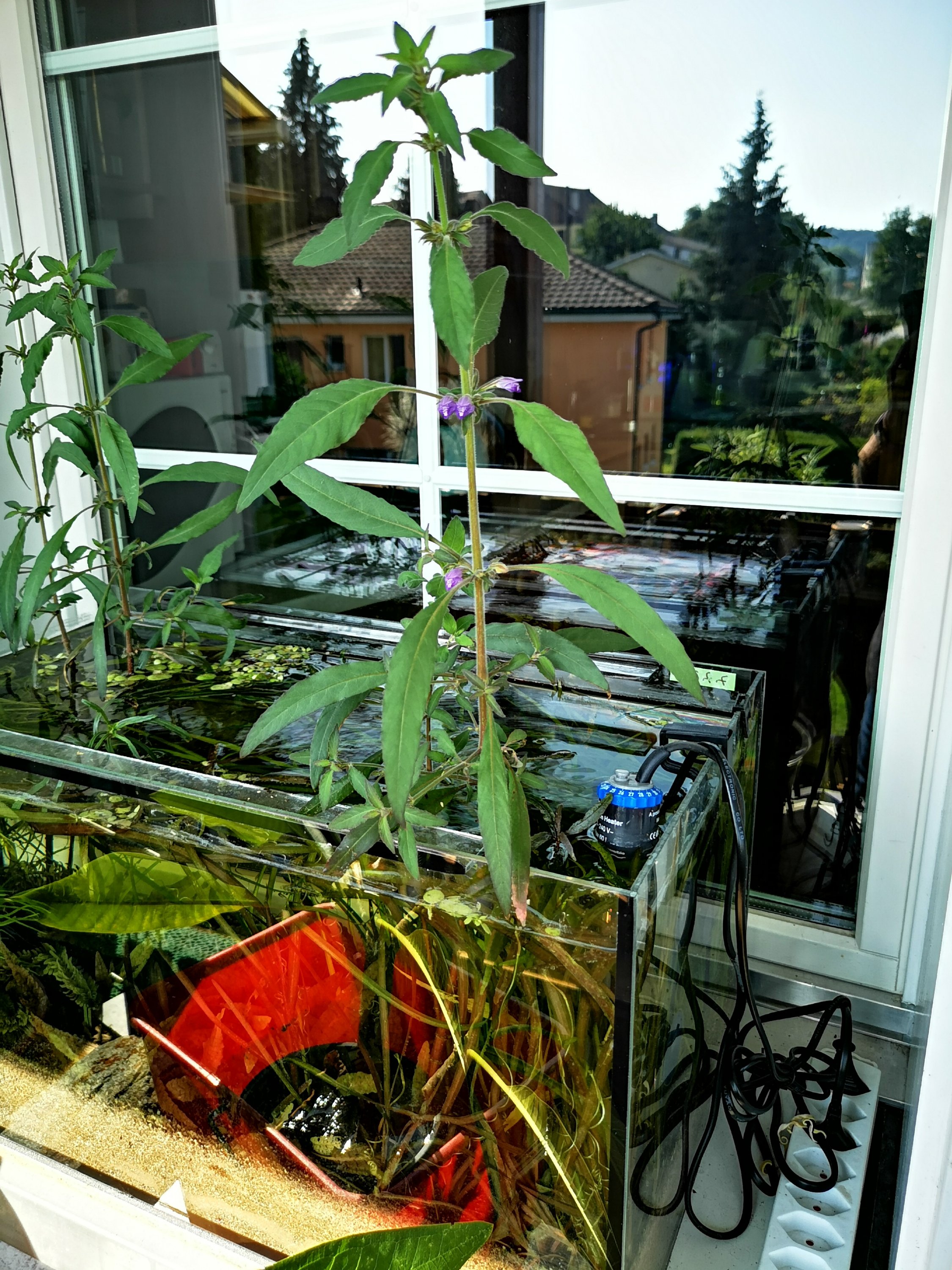
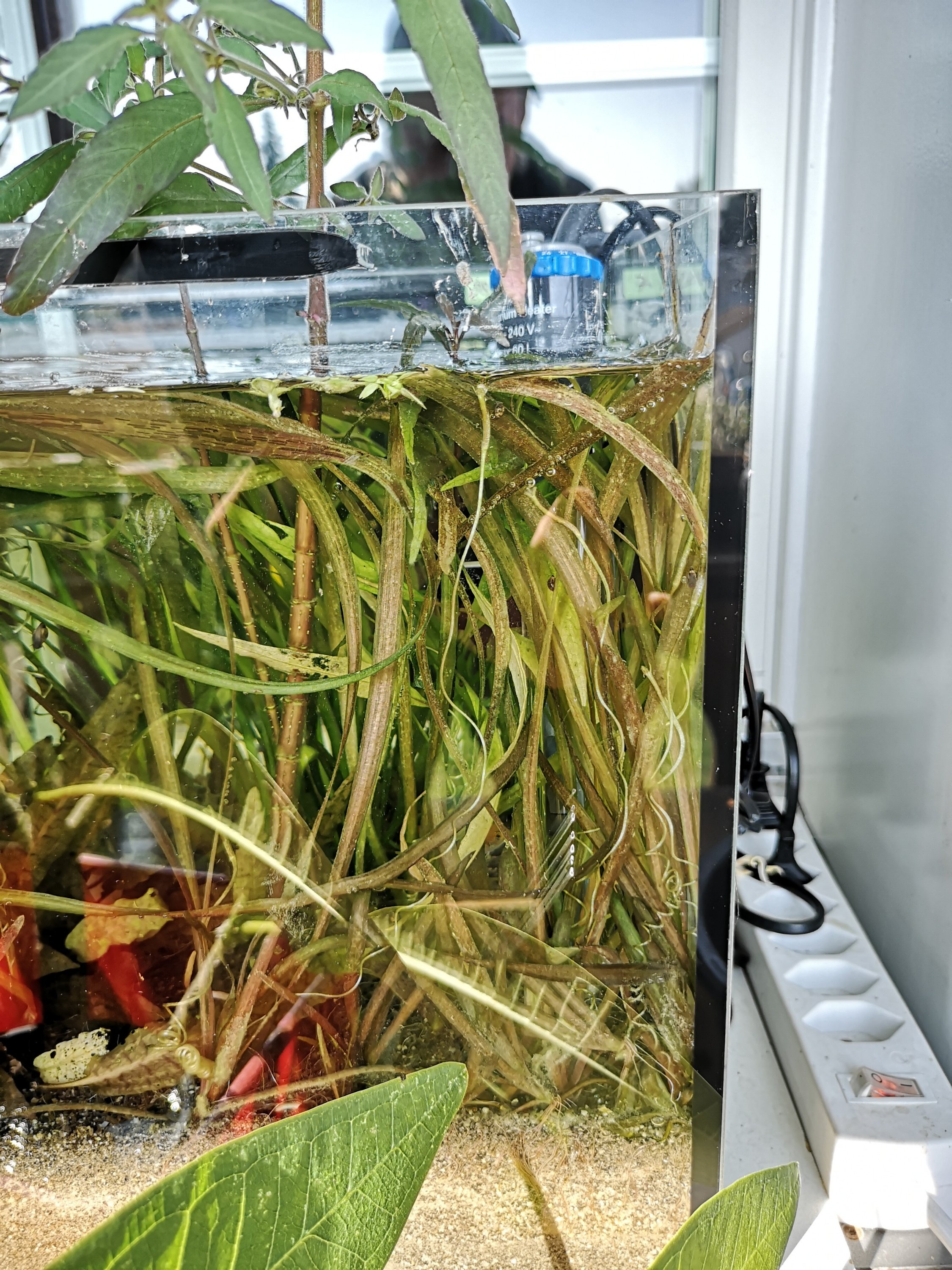
Das kleine 54 Liter „FensterbankBecken“ (Start 07.07.2020) hat eine neue LED Leuchte bekommen. Der Wasserfreund (hydrophila odora) wächst und blüht immer noch aus dem Becken heraus. Den Guppys geht es gut. Die Antennenwelse wachsen. Die Armano Japonica leben noch und putzen das Aquarium. Dem Honiggourami Pärchen geht es gut.
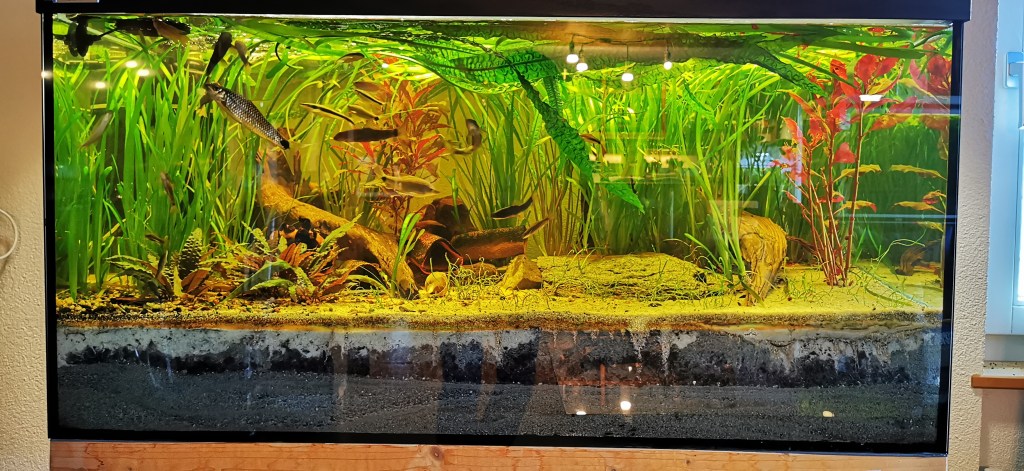
Das „WhiteSandsTank“ Aquarium 250 Liter Lowtech Walstad DeepSoil
Das am 10.10.2020 auf „Walstad Deep Soil“ umgebaute „WhiteSandsTank“ läuft auch super. Es hat nur einen kleinen Filter, der auch als Pumpe zur Wasserbewegung dient. Oben drauf liegt eine 840er Fluorescent Leuchte. Das Substrat besteht aus 12 cm Spielesand und 2cm Torf. Es sind Antennenwelse drin, Puzzlebarben, Siamesische Rüsselbarben, Paradiesfische und Garra Rufa.
Macropodus Opercularis Nachwuchs
Und hier noch zwei Bilder vom Paradiesfischnachwuchs.
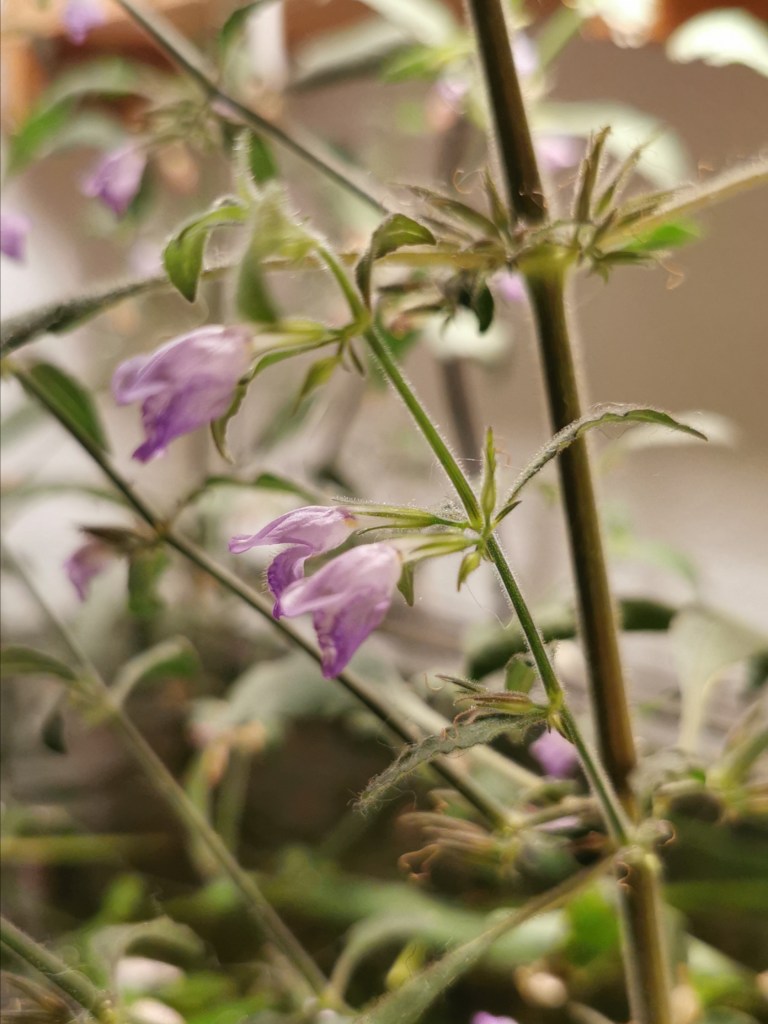
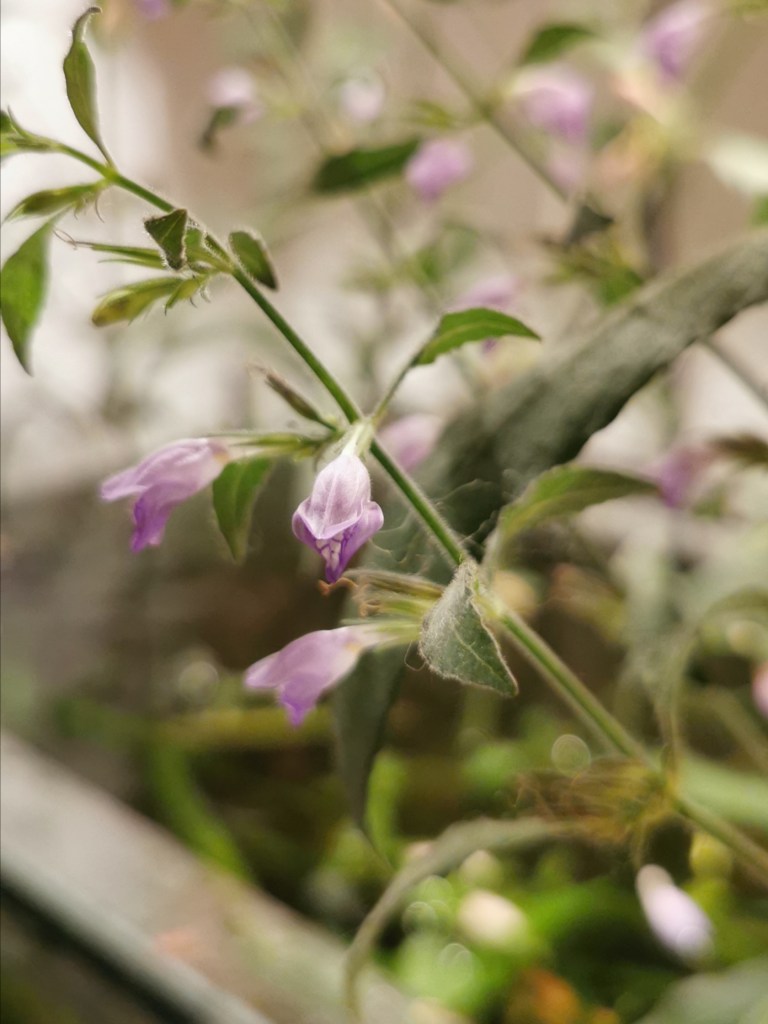
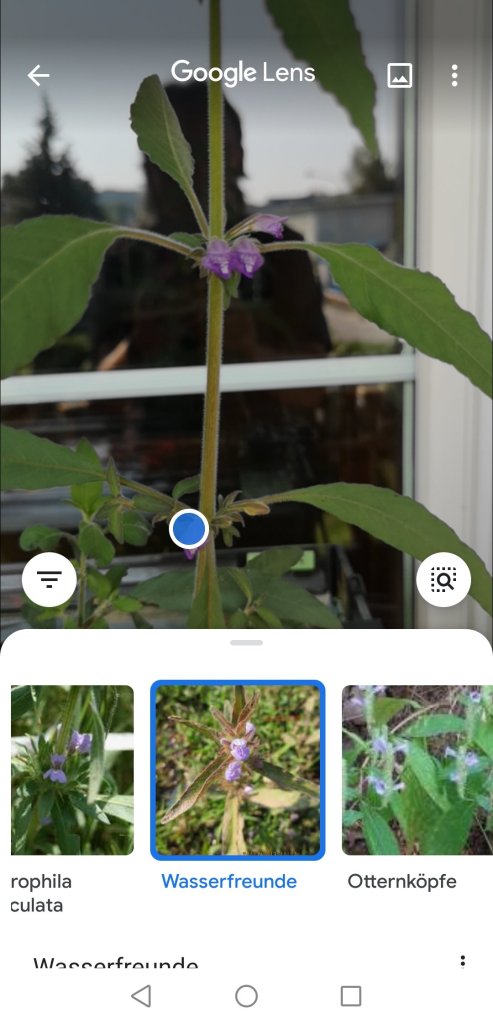
Jedesmal, wenn ich die angefallenen Blüten der Aquarienpflanze „Wasserfreund“ einsammle und wieder in das Becken werfe, rieche ich den intensiven Duft. Die Schnecken lieben die Blüten. Ich liebe den Duft. Auch wenn man die Blätter oder die Stengel berührt, duften die Finger sofort.
Nun habe ich mal kurz „gegurgelt“ und prompt wurde diese Art nach eben diesem intensiven Duft benannt: „Hygrophila Odora“.
„Diese Pflanze wurde vor einigen Jahren unter den Bezeichnungen Hygrophila sp. ‚Guinea‘ und H. sp. ‚Afrika‘ als Aquarienpflanze bekannt. Im Jahr 2009 wurde sie von Kai Vollesen (Kew, England) als Hygrophila odora bestimmt.
Der Duftende Wasserfreund ist eine in Westafrika verbreitete Sumpfpflanze, die unter anderem an Flussrändern wächst. Die Art kommt z.B. im Niokolo-Koba-Nationalpark im Senegal vor. In Afrika sind relativ viele Hygrophila-Arten endemisch, aber im Aquarienhobby ist Hygrophila odora die erste und bisher (2013) einzige afrikanische Wasserfreund-Art. Sie ist offenbar kaum im Handel erhältlich und wird wahrscheinlich nur von wenigen Hobbyisten gepflegt.“ (Quelle)
Der Duftende Wasserfreund wächst aus dem „FensterbankBecken“ heraus.
In meinem „KitchenWindowTank“ (FensterbankBecken) wachsen die Pflanzen massiv aus dem Becken heraus und blühen pausenlos.
Heute fand die monatliche Fischbörse des Aquaristik Vereins Winterthur statt. Zusammen mit meinem Nachbarn, der seit 4 Wochen ein 300 Liter Becken betreibt, und meinem Besuch aus Regensburg fuhren wir zum Vereinsheim.
Dort gefielen mir die Schleierschwanz -Schwertträger extrem gut. Somit kaufte ich den gesamten Schwarm mit 10 Stück. Mit der schönen dunklen roten Farbe bringen sie einen tollen Farbakzent ins Becken. Mein Nachbar nahm 6 Schwertträger „Koi“ mit.
Aktuell befinden sich folgende Arten in meinem Becken:


 Veröffentlicht von PeterPan