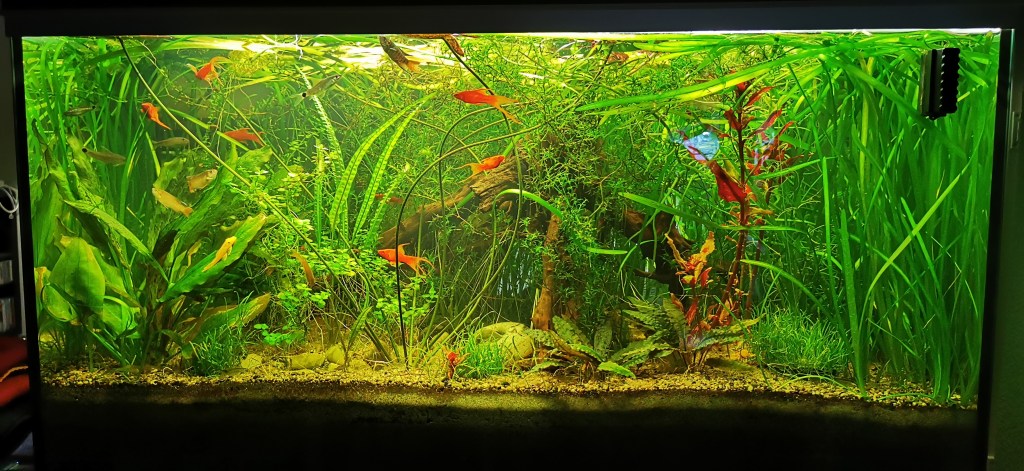
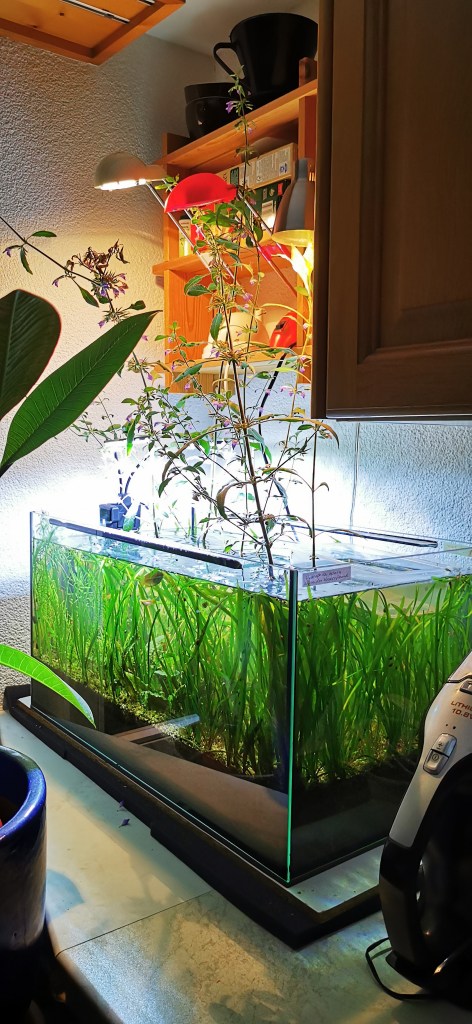
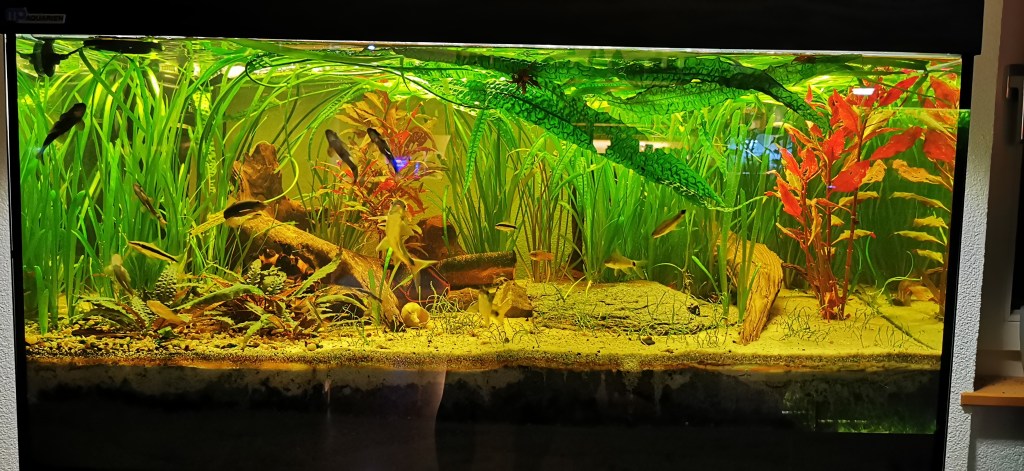
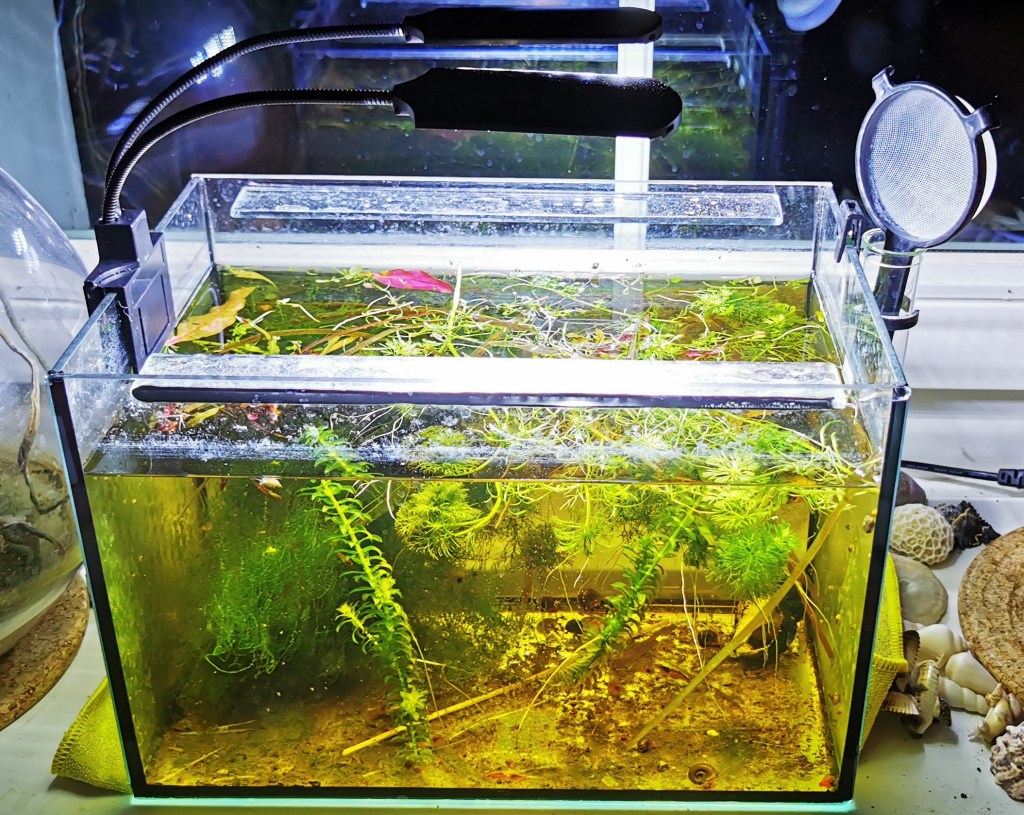
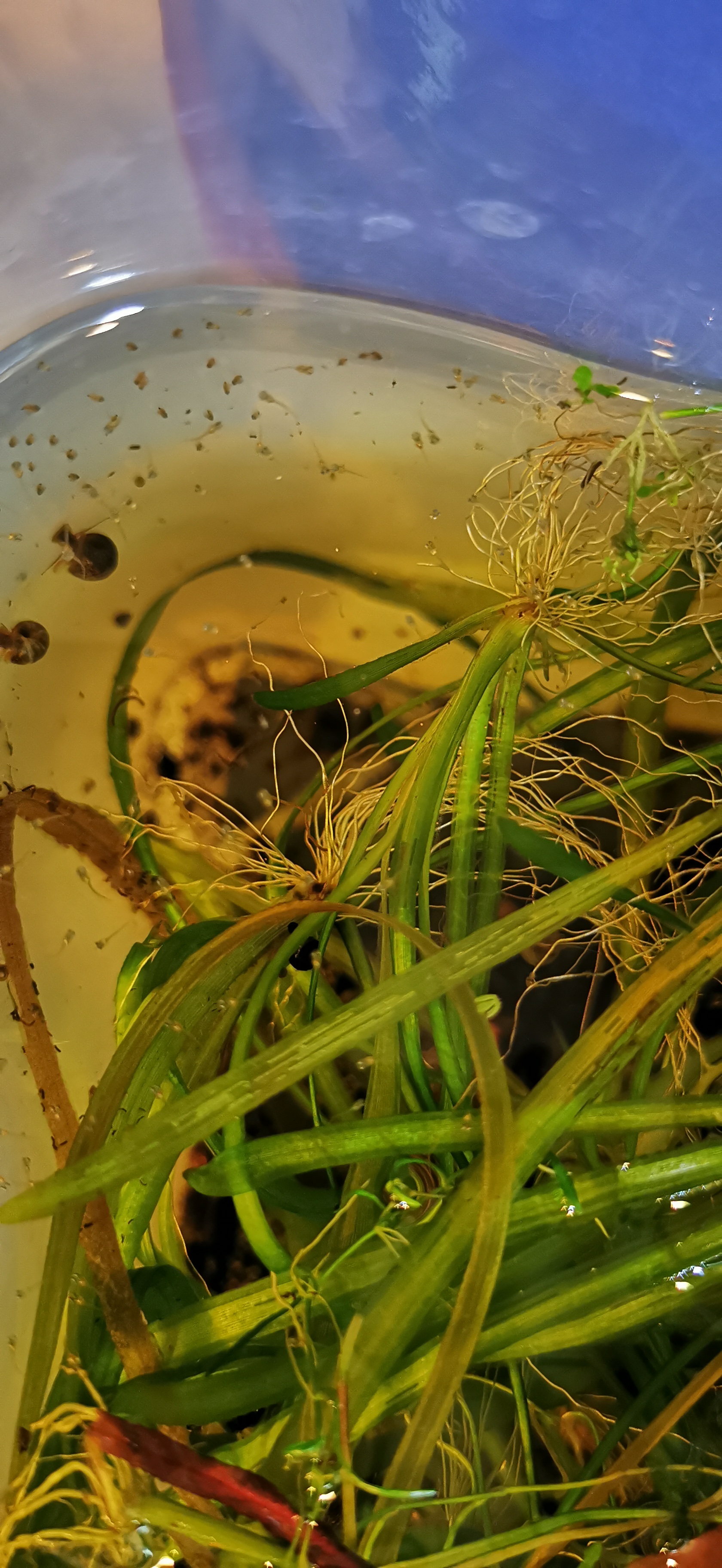
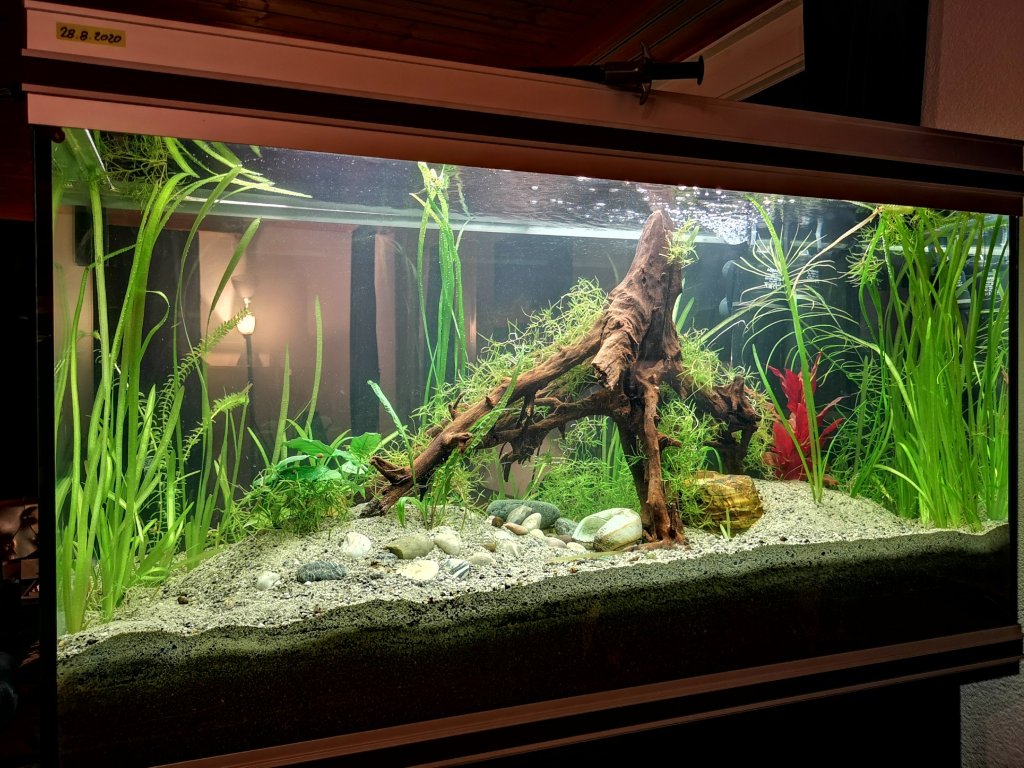
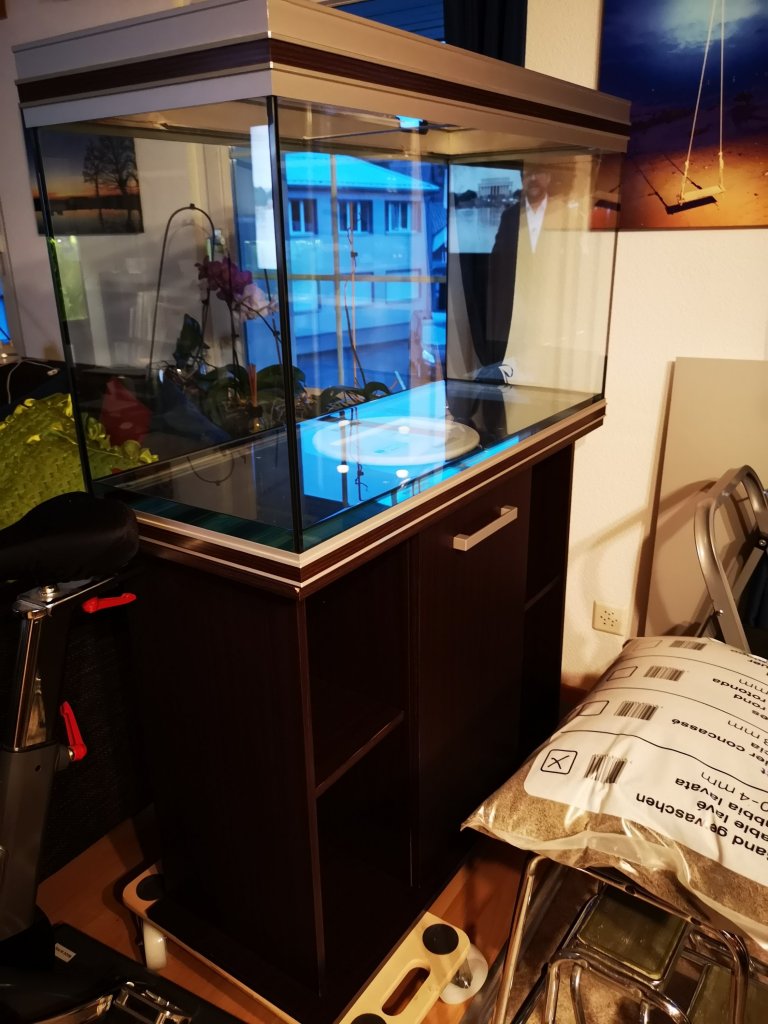
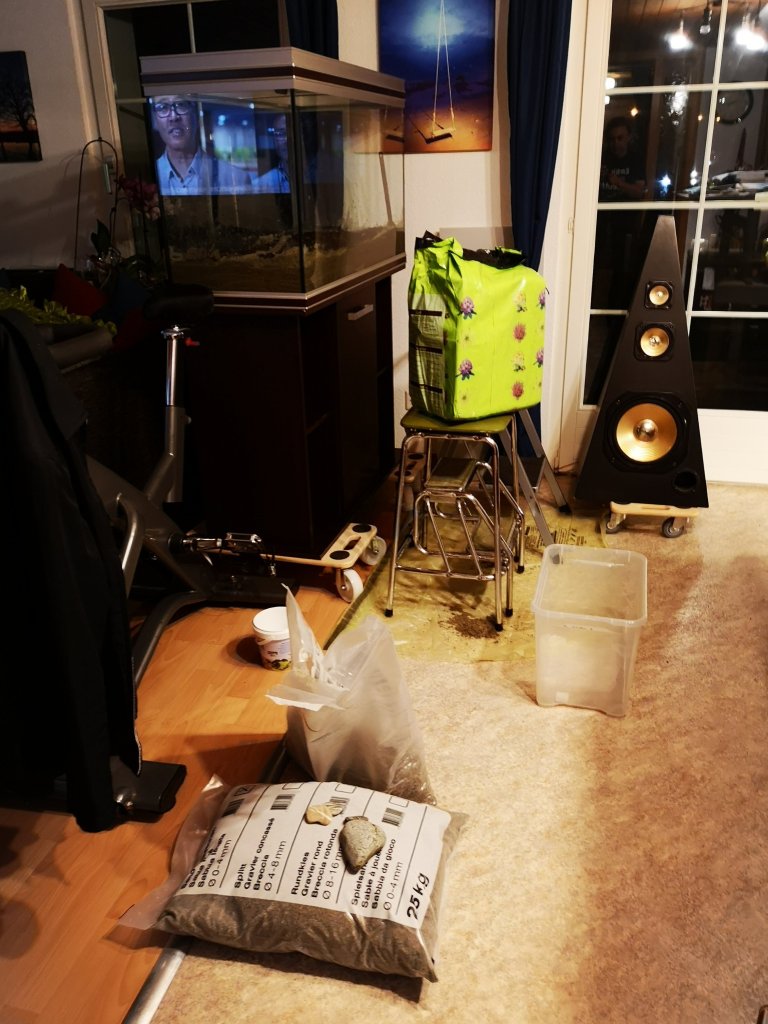
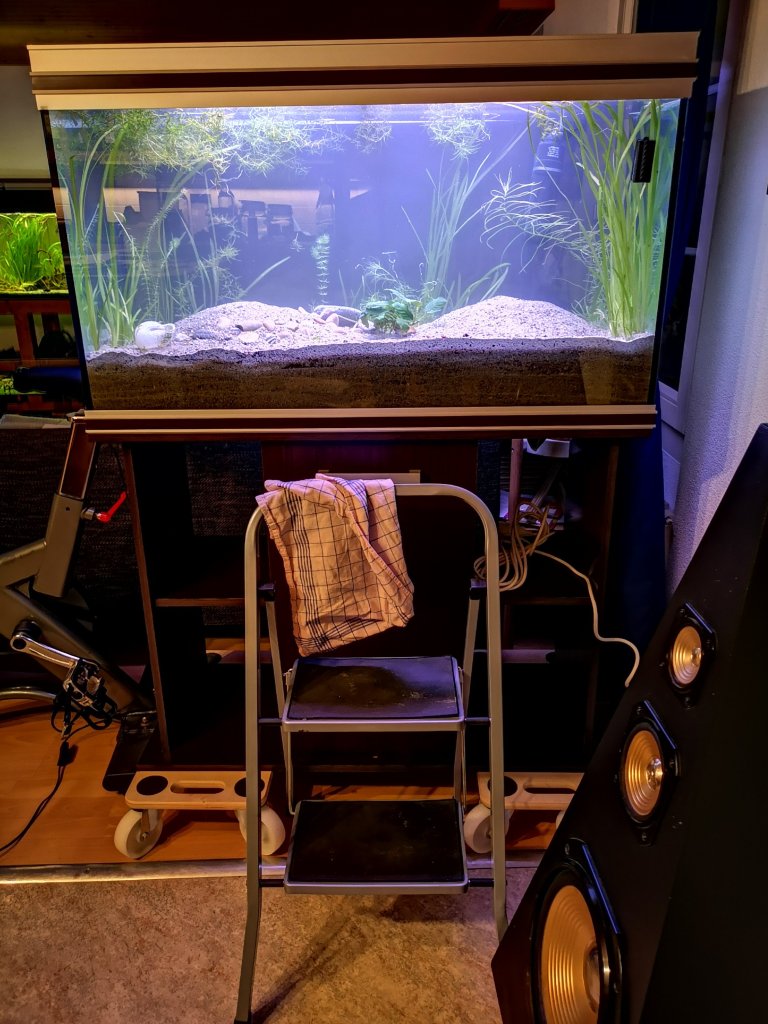
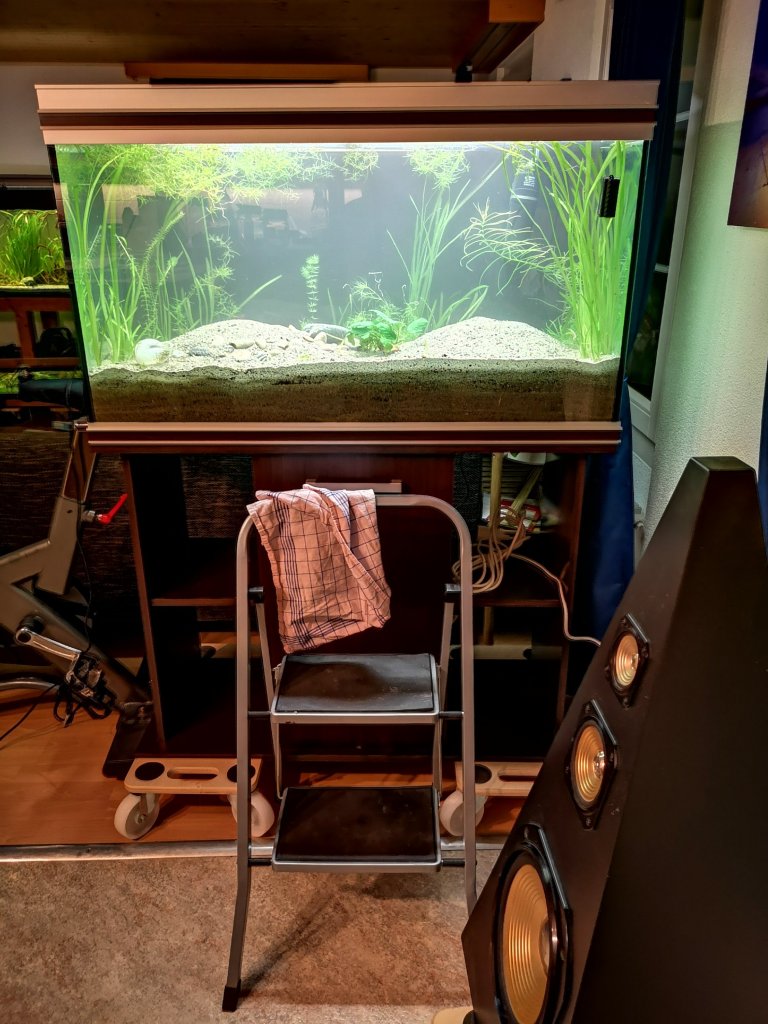
Here’s a little update on my low-maintenance aquarium projects. Over the weekend I threw away two buckets of Vallisneria plants. Thus, the small 60’s baby pool and the DeepSand 350’s pool thinned out. I also cleaned the pumps.
The viewer will notice that everything is so quiet. No, I did not turn off the sound of the video. I use almost no technology. Only lighting and small pumps. And I turn them off together overnight. Thus, the method is considered „LowTech“.
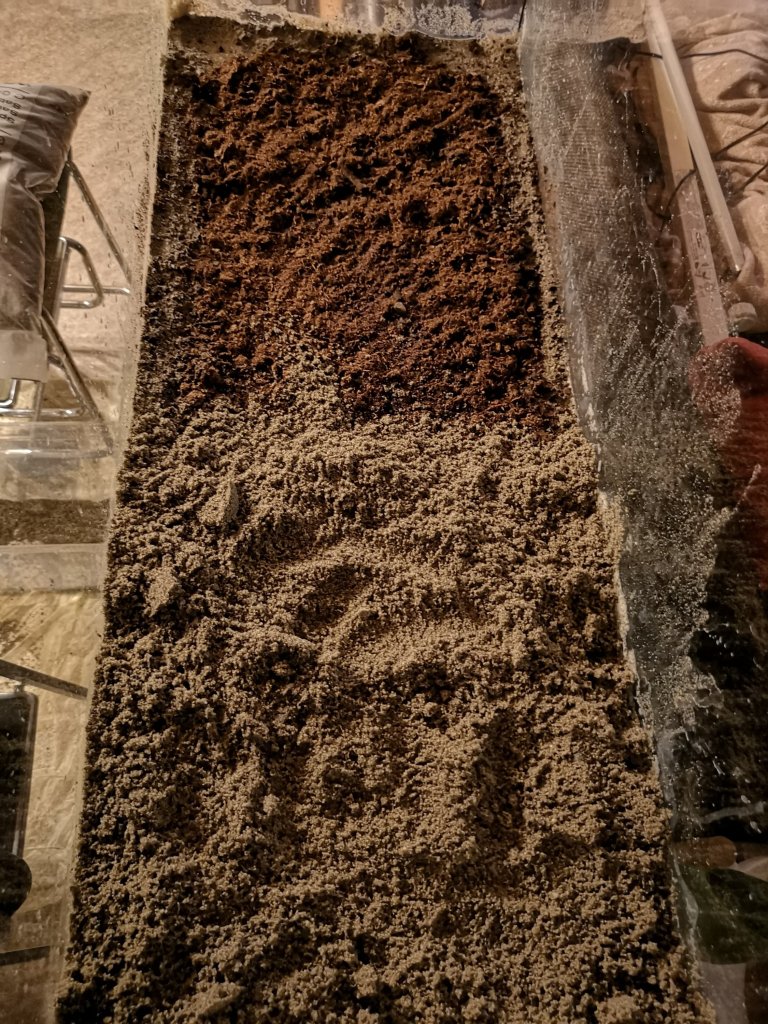
I basically use „DeepSoil“ combined with „Walstad“. I use peat instead of simple potting soil. This because I am convinced that the tannins in peat have an antibacterial effect and that is perfect for the health of living beings. And secondly, the fertilizing effect of the peat has a more positive effect on the plants than artificial fertilization due to the slow decomposition over a longer period of time.
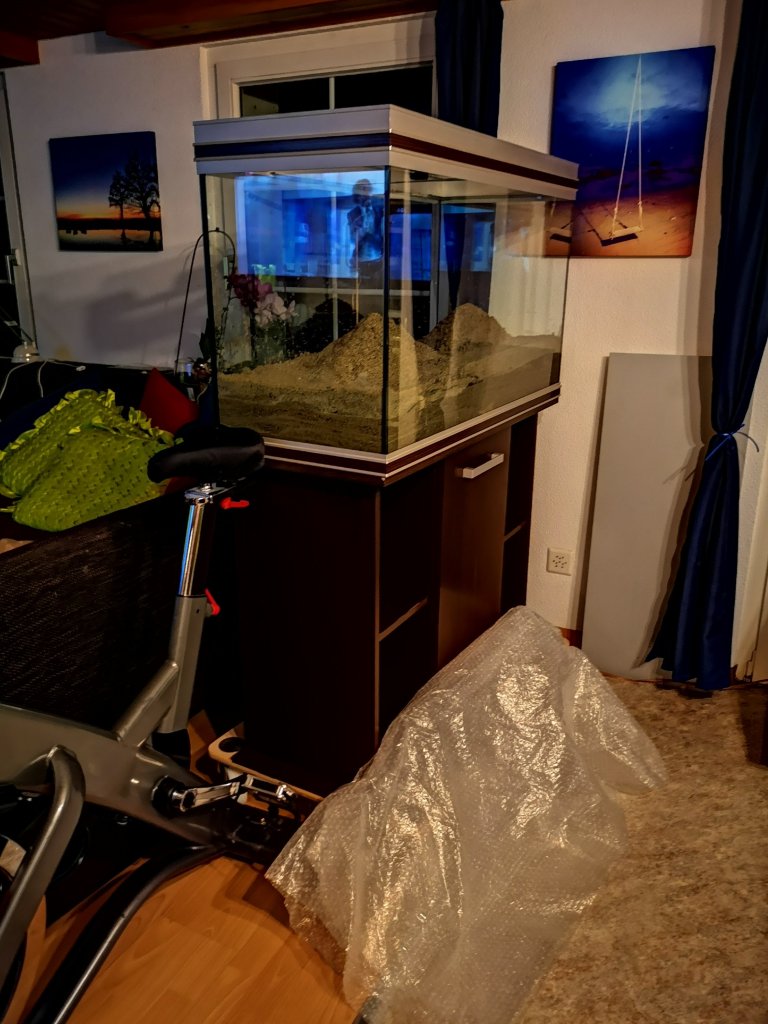
The peat is in the middle of the „substrate“, which consists of simple sandbox sand. Only with the 125 Tank did I use dark, fine-grained split for testing.
But I would generally recommend sand, because then the roots grow deeper and finer faster. It is also easier for the malaysian trumpet snails to dig up the sand and convert waste into nutrients than with gravel or grit, the grains of which are larger and heavier.
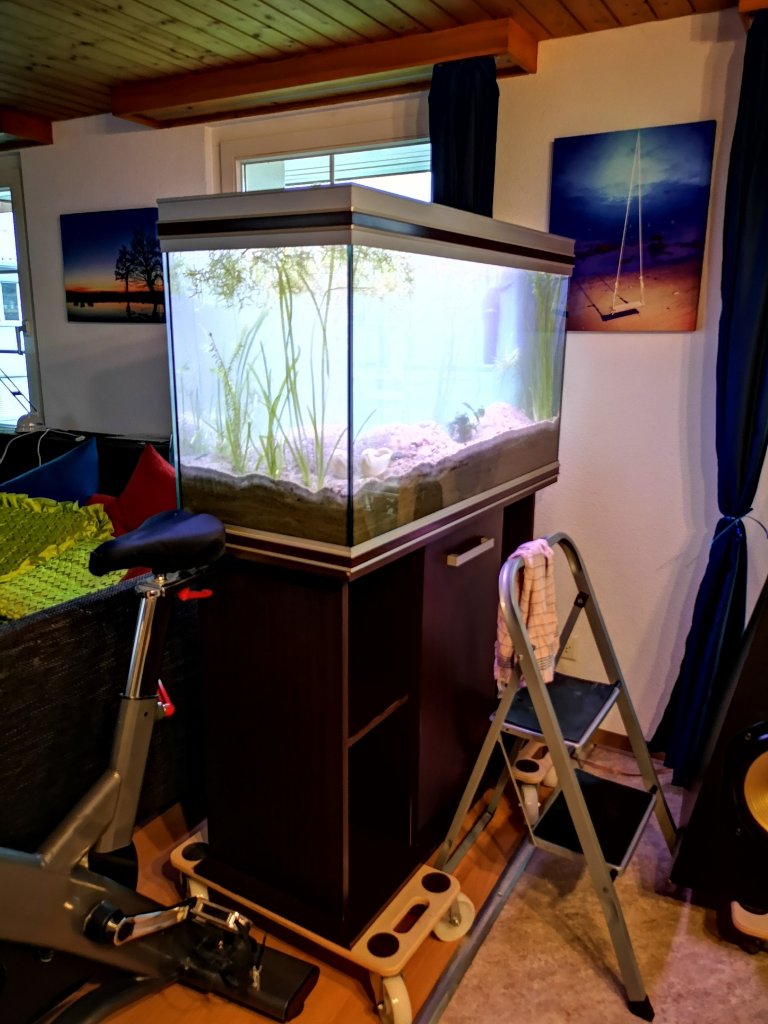
The planting in the tanks is a mixture of slow-growing and fast-growing plants.
The use of Duckweed has turned out to be important. Duckweed growth is an indicator of the amount of nutrients in the tank. If there is a lot of duckweed in a tank, then there are not enough fast-growing plants. If the duckweed develops negatively, i.e. does not reproduce, then the proportion of plants in the tank is optimal. The Plants absorb all the nutrients and there is nothing left for duckweed.
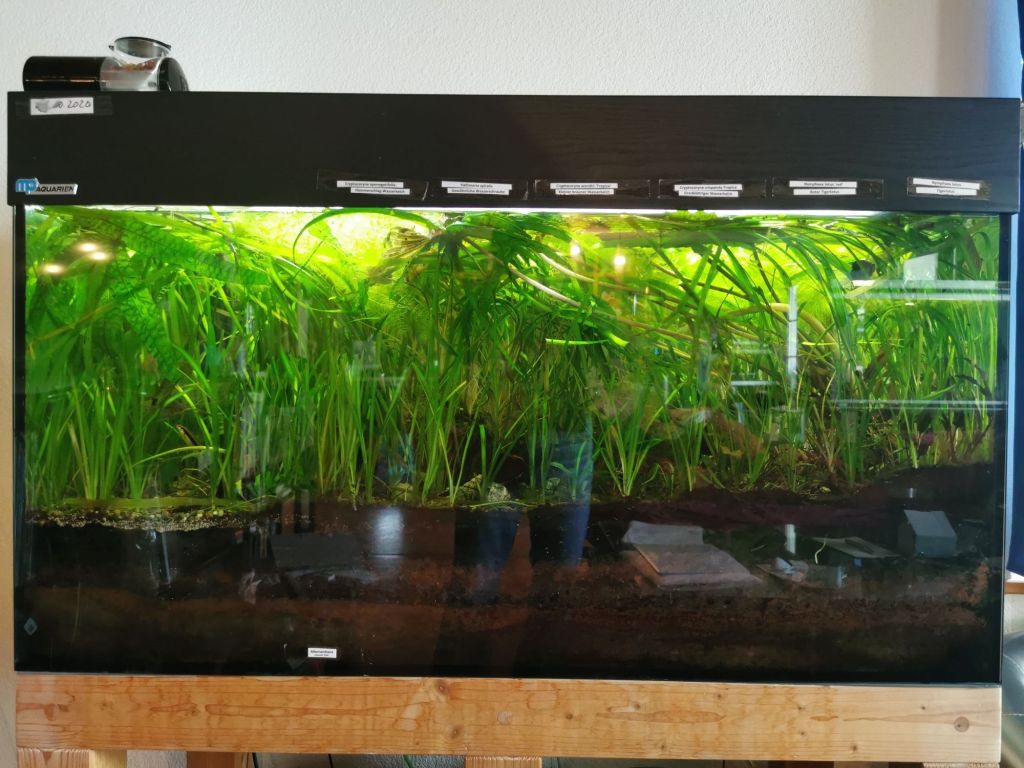
As fast-growing plants I use Vallisneria, Hydrophilia (water lover) and Hornwort (featherwort). In addition, there is tiger lotus, which blooms one after the other in the „WhiteSandsTank“ every week. In addition, Cryptocoryne in all possible variants.
In the small baby Tank, the small Cryptocoryne variant develops excellently due to the shallow water depth. Chrismasmoss serves to protect youngsters fish on the ground below and the small bacopa (Bacopa monnerie) on top, which constantly blooms purple above the surface.
On the subject of snails. I don’t really understand the hysteria that often prevails here. Snails are important components in the aquarium ecosystem. The system does not work without snails.
In short: snails eat the garbage and the algae in the aquarium excrete nutrients. Bladder snails and ramshorn snails tend to the cleaning troop above the ground. And in the ground, malaysian trumpet snails dig through the sand and eat dead plant parts and other biological garbage. Fertilizer for the plants comes out of the snails at the back. As we all know compared with earthworms.
So, if we know now about Snails that they eat all the garbage and the amout of snails is direct proportional to the food for them: If you have a „snail explosion“ in your tank the solution is NOT to buy a Fish to kill them. The solution is to stop putting in Food that gets garbage, because the fish cannot eat all of it.
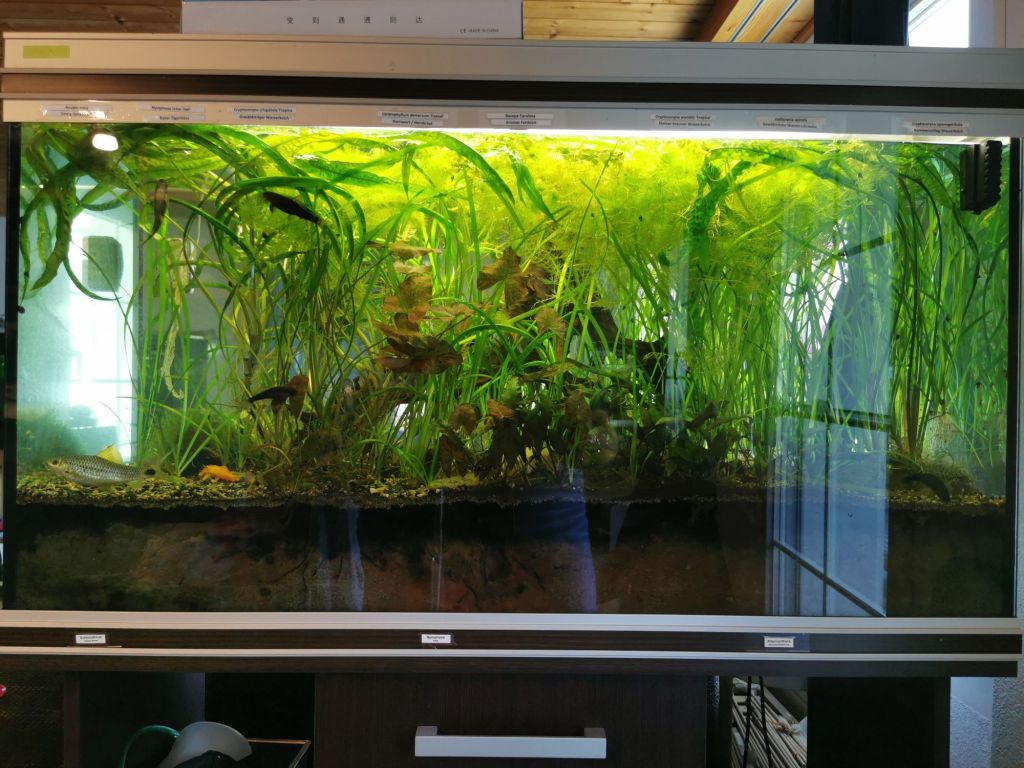
I’ve never done water tests. But once and then Mam laughed at me about what I want to do with the chemistry kit. Our family has been in aquaristics for over 50 years. Except that I’m not a „technology junkie“ like my dad, but work according to the „natural aquarium“ method.
There are many natural signs of bad water. For example, when the malaysian trumpet snails on the glass move to the surface at night when the pump is switched off. Then there is not enough oxygen in the tank below. Something is wrong. The pump is clogged. Or it just needs a water change.
Ah, the subject of water changes. In my tank or in my method (DeepSoil&Walstad&LowTech) it only needs a water change every 3-6 months. In my opinion, frequent water changes destroy the biological balance in the tank. This is additional stress for the fish. It takes days for the balance to be restored. Totally unnecessary.
Any noise in the Tank is just as unnecessary. Constant noise stresses living beings, makes them more susceptible to diseases and has a negative effect on life expectancy.
That’s why there is no need for a „bubbler“ in the aquarium. The original argument for a bubbler is „more oxygen“. But if you use my method with „many plants“ they produce enough oxygen. In addition, a lack of oxygen is assimilated (transferred) via the water surface depending on the water temperature. Bubblers are completely unnecessary.
Everything that is made of plastic does not need it in the aquarium either. No plastic plants and no plastic decoration. What is not good in nature is not needed in the aquarium either.
Pebbles are used as decoration. Please no limestones. In my opinion, wood is also very important. Wood is used by catfish for digestion. They also like to grate bacteria and fresh algae off the wood. The wood stabilizes the water quality and serves due to its fine pores as a habitat for useful nitrite bacteria.
Nitrite bacteria convert (poisonous) nitrite into nitrate. Nitrite is an intermediate in the aquarium’s nitrogen cycle. That’s why you have to let a new aquarium run without fish for at least 6 weeks. Nitrite bacteria live everywhere in the aquarium, on stones, on plants, a lot in the wood, a lot in the substrate on the ground and a lot in the filter.
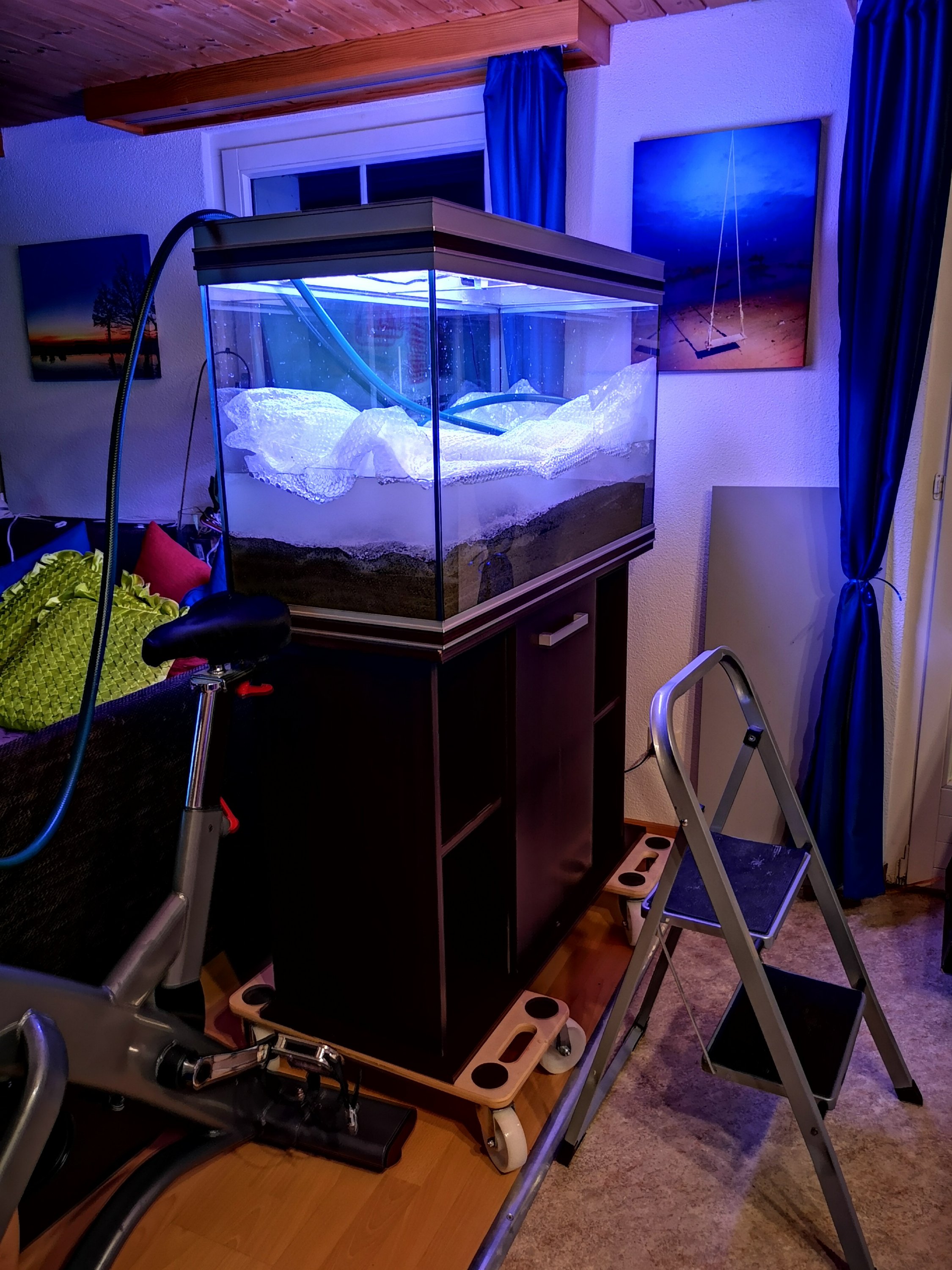
Thus, a large external filter not only brings a lot of filter performance, but also a large amount of nitrite bacteria. However, this carries the risk that in the event of a power failure or other filter failure, the nitrite that then accumulates in the tank will poison the creatures and fish. That’s why I use the method without a filter. My nitrite bacteria all live in the tank. There is no risk of filter failure and of nitrite killing my fish during power failure.
Why I don’t need a filter? Now this could get a bit complicated. I try it:
- I feed the fish
- The fish therefore have excretions
- The excretions and leftover food are converted by the snails into nutrients for the plants.
- The nutrients ensure good healthy plant growth. Especially with fast-growing plants.
- I regularly take plant material from the aquarium
In addition, all nitrite bacteria are in my aquariums. So there is no reason to use a filter in my aquarium.
So what are my tips for beginners?
- Never trust the aquarium industry
- Don’t spend too much money on unnecessary clutter.
- Don’t buy plastic
- Don’t buy special substrates.
- Don’t buy expensive lighting.
- Don’t buy a big filter.
An easy-to-maintain aquarium needs
- A glass basin
2a. Sand as soil substrate at least 6 cm. Better more.
2b. If you want to do the Walstad method: 3cm sand / 1cm peat / 3cm sand - A few pebbles. No limestone (vinegar test)
- Wood for the catfish and for stable water quality.
- A few slow-growing plants for the foreground
- Lots of fast-growing plants for the background.
- A small motorized pump.
- If you absolutely want to have a filter: A small motorized internal filter.
- A simple lighting. (color daylight)
- A simple timer for lights and pump/filter
- Bladder and ramshorn snails, as well as tower snails as garbage collectors and cleaning crews and fertilizer producers
- Easy to keep fish.
If you work like i recommend, you will have never a problem with cloudy (caused by Bacteria) or green (caused by green algea) water. Because the fast growing plants will always win the race for the nutrients.
So you will have fun with the aquaristic for a long time. From the Beginning.


 Veröffentlicht von PeterPan