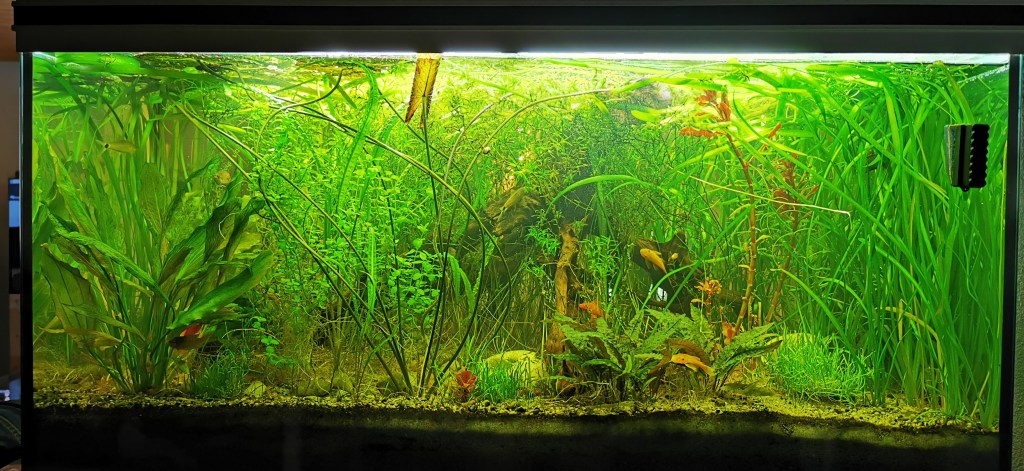
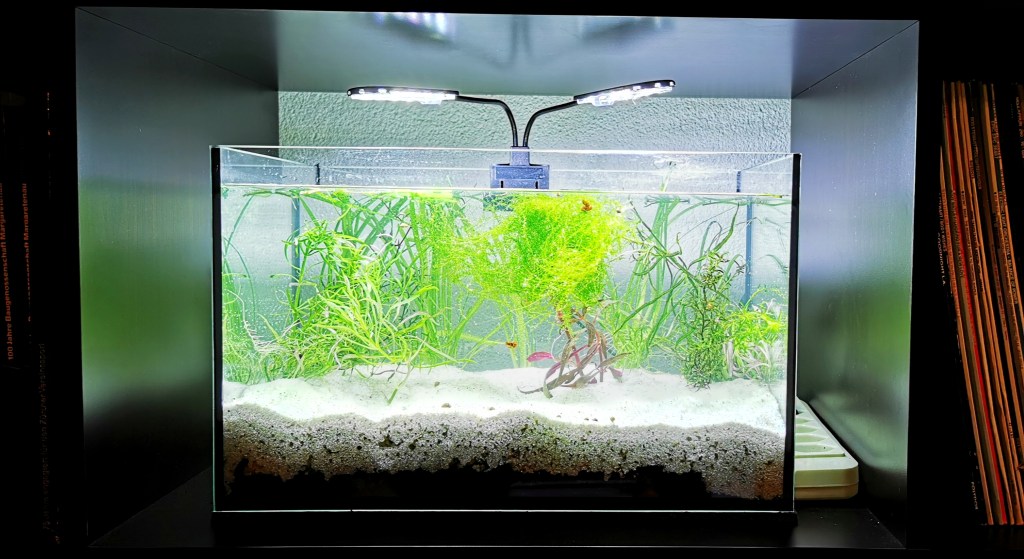
In meinem „DeepSoilTank“ blüht über den Sommer hinweg die TigerLotus jeden Monat. Allerdings öffnet sich die Blüte ganz nur nachts. Mitten in der Nacht. Und nur für eine Nacht.
Dann vergeht sie und die nächste Blüte „schiesst“ 30 Tage lang vom Pflanzenansatz bis hinauf über die Wasseroberfläche.
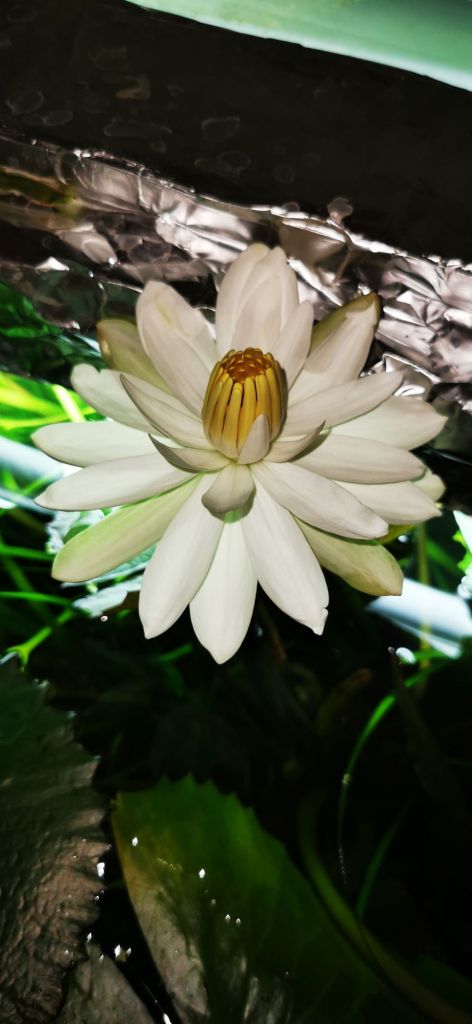
Die KI meint zum Bild oben: Bei der Pflanze auf dem Bild handelt es sich um eine weiß blühende Seerose (Gattung Nymphaea). Im Aquarien- und Teichhobby entspricht diese Blüte sehr wahrscheinlich dem Ägyptischen Weißen Lotos (Nymphaea lotus), der auch häufig unter dem Namen Tigerlotus gehandelt wird.
Blütenverhalten: Die Blüten des Weißen Tigerlotus öffnen sich typischerweise nachts oder in den frühen Morgenstunden und schließen sich bei starkem Tageslicht wieder.
Sind Fische tatsächlich dumm? Oder halten die Menschen sie nur dafür? Fische gelten gemeinhin als stumme, ausdruckslose Wesen ohne Gedächtnis, Gefühle oder sogar ohne Schmerzempfinden. Dabei entdeckt die Wissenschaft immer neue, erstaunliche Eigenschaften und Fähigkeiten der Wasserbewohner.
So verfügen sie anscheinend über ein reges Sozialleben, große Anpassungsfähigkeit und echte Emotionen. „Fische – Schlauer als gedacht?“ ist eine humorvolle und lehrreiche Entdeckungsreise durch die wundersame Wasserwelt, vom Goldfischglas im Wohnzimmer über exotische Korallenriffe bis in die türkisblauen Lagunen von Moorea. Die Dokumentation hinterfragt dabei auch ganz allgemein das Verhältnis des Menschen zur Intelligenz der Tiere.
Here’s a little update on my low-maintenance aquarium projects. Over the weekend I threw away two buckets of Vallisneria plants. Thus, the small 60’s baby pool and the DeepSand 350’s pool thinned out. I also cleaned the pumps.
The viewer will notice that everything is so quiet. No, I did not turn off the sound of the video. I use almost no technology. Only lighting and small pumps. And I turn them off together overnight. Thus, the method is considered „LowTech“.
I basically use „DeepSoil“ combined with „Walstad“. I use peat instead of simple potting soil. This because I am convinced that the tannins in peat have an antibacterial effect and that is perfect for the health of living beings. And secondly, the fertilizing effect of the peat has a more positive effect on the plants than artificial fertilization due to the slow decomposition over a longer period of time.
The peat is in the middle of the „substrate“, which consists of simple sandbox sand. Only with the 125 Tank did I use dark, fine-grained split for testing.
But I would generally recommend sand, because then the roots grow deeper and finer faster. It is also easier for the malaysian trumpet snails to dig up the sand and convert waste into nutrients than with gravel or grit, the grains of which are larger and heavier.
The planting in the tanks is a mixture of slow-growing and fast-growing plants.
The use of Duckweed has turned out to be important. Duckweed growth is an indicator of the amount of nutrients in the tank. If there is a lot of duckweed in a tank, then there are not enough fast-growing plants. If the duckweed develops negatively, i.e. does not reproduce, then the proportion of plants in the tank is optimal. The Plants absorb all the nutrients and there is nothing left for duckweed.
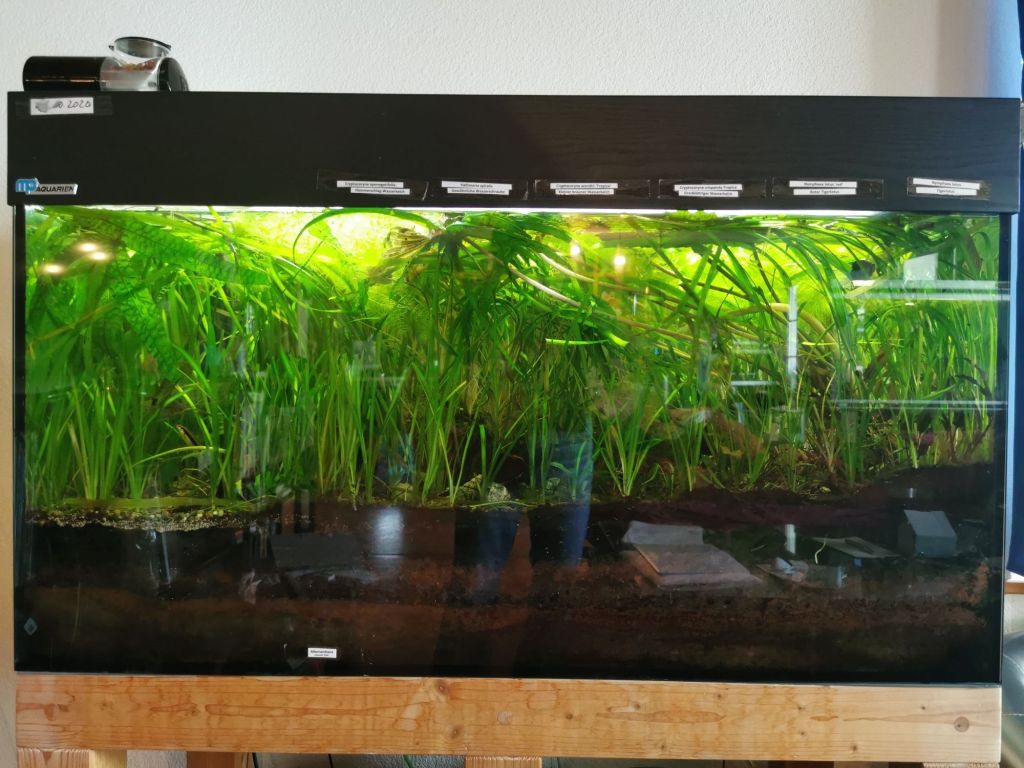
350 Litre DeepSoilTank started 2020
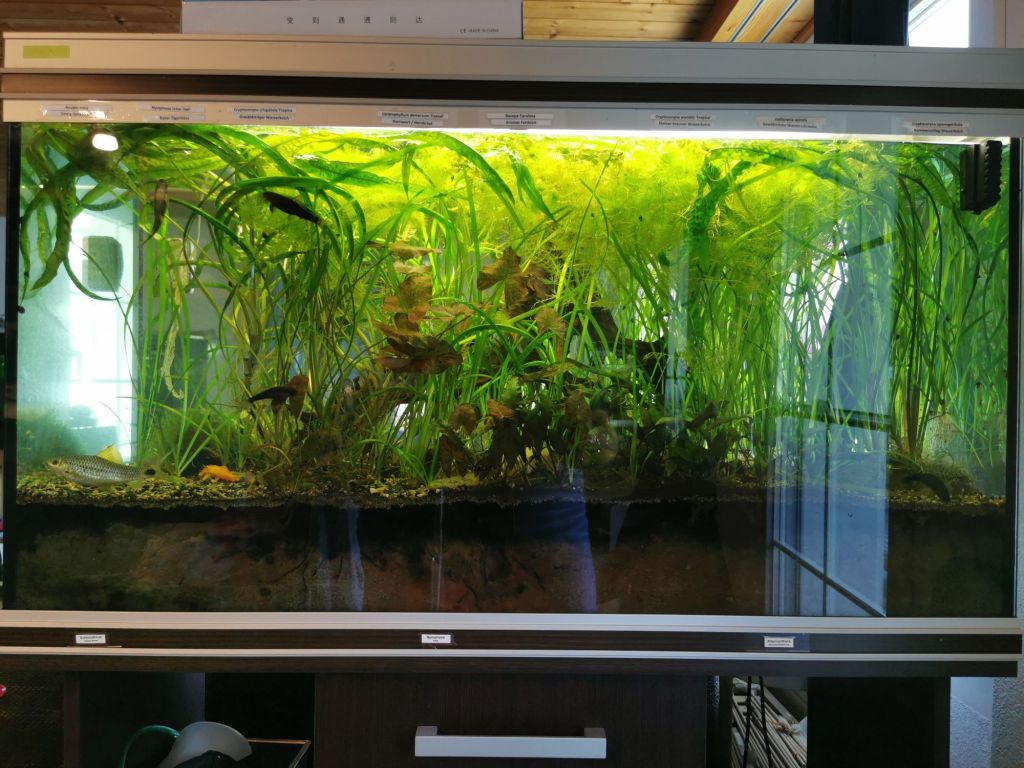
As fast-growing plants I use Vallisneria, Hydrophilia (water lover) and Hornwort (featherwort). In addition, there is tiger lotus, which blooms one after the other in the „WhiteSandsTank“ every week. In addition, Cryptocoryne in all possible variants.
In the small baby Tank, the small Cryptocoryne variant develops excellently due to the shallow water depth. Chrismasmoss serves to protect youngsters fish on the ground below and the small bacopa (Bacopa monnerie) on top, which constantly blooms purple above the surface.
On the subject of snails. I don’t really understand the hysteria that often prevails here. Snails are important components in the aquarium ecosystem. The system does not work without snails.
In short: snails eat the garbage and the algae in the aquarium excrete nutrients. Bladder snails and ramshorn snails tend to the cleaning troop above the ground. And in the ground, malaysian trumpet snails dig through the sand and eat dead plant parts and other biological garbage. Fertilizer for the plants comes out of the snails at the back. As we all know compared with earthworms.
So, if we know now about Snails that they eat all the garbage and the amout of snails is direct proportional to the food for them: If you have a „snail explosion“ in your tank the solution is NOT to buy a Fish to kill them. The solution is to stop putting in Food that gets garbage, because the fish cannot eat all of it.
350 Litre DeepSoilTank started 2021
I’ve never done water tests. But once and then Mam laughed at me about what I want to do with the chemistry kit. Our family has been in aquaristics for over 50 years. Except that I’m not a „technology junkie“ like my dad, but work according to the „natural aquarium“ method.
There are many natural signs of bad water. For example, when the malaysian trumpet snails on the glass move to the surface at night when the pump is switched off. Then there is not enough oxygen in the tank below. Something is wrong. The pump is clogged. Or it just needs a water change.
Ah, the subject of water changes. In my tank or in my method (DeepSoil&Walstad&LowTech) it only needs a water change every 3-6 months. In my opinion, frequent water changes destroy the biological balance in the tank. This is additional stress for the fish. It takes days for the balance to be restored. Totally unnecessary.
Any noise in the Tank is just as unnecessary. Constant noise stresses living beings, makes them more susceptible to diseases and has a negative effect on life expectancy.
That’s why there is no need for a „bubbler“ in the aquarium. The original argument for a bubbler is „more oxygen“. But if you use my method with „many plants“ they produce enough oxygen. In addition, a lack of oxygen is assimilated (transferred) via the water surface depending on the water temperature. Bubblers are completely unnecessary.
Everything that is made of plastic does not need it in the aquarium either. No plastic plants and no plastic decoration. What is not good in nature is not needed in the aquarium either.
Pebbles are used as decoration. Please no limestones. In my opinion, wood is also very important. Wood is used by catfish for digestion. They also like to grate bacteria and fresh algae off the wood. The wood stabilizes the water quality and serves due to its fine pores as a habitat for useful nitrite bacteria.
Nitrite bacteria convert (poisonous) nitrite into nitrate. Nitrite is an intermediate in the aquarium’s nitrogen cycle. That’s why you have to let a new aquarium run without fish for at least 6 weeks. Nitrite bacteria live everywhere in the aquarium, on stones, on plants, a lot in the wood, a lot in the substrate on the ground and a lot in the filter.
Thus, a large external filter not only brings a lot of filter performance, but also a large amount of nitrite bacteria. However, this carries the risk that in the event of a power failure or other filter failure, the nitrite that then accumulates in the tank will poison the creatures and fish. That’s why I use the method without a filter. My nitrite bacteria all live in the tank. There is no risk of filter failure and of nitrite killing my fish during power failure.
Why I don’t need a filter? Now this could get a bit complicated. I try it:
I feed the fish
The fish therefore have excretions
The excretions and leftover food are converted by the snails into nutrients for the plants.
The nutrients ensure good healthy plant growth. Especially with fast-growing plants.
I regularly take plant material from the aquarium
In addition, all nitrite bacteria are in my aquariums. So there is no reason to use a filter in my aquarium.
So what are my tips for beginners?
Never trust the aquarium industry
Don’t spend too much money on unnecessary clutter.
Don’t buy plastic
Don’t buy special substrates.
Don’t buy expensive lighting.
Don’t buy a big filter.
An easy-to-maintain aquarium needs
A glass basin 2a. Sand as soil substrate at least 6 cm. Better more. 2b. If you want to do the Walstad method: 3cm sand / 1cm peat / 3cm sand
A few pebbles. No limestone (vinegar test)
Wood for the catfish and for stable water quality.
A few slow-growing plants for the foreground
Lots of fast-growing plants for the background.
A small motorized pump.
If you absolutely want to have a filter: A small motorized internal filter.
A simple lighting. (color daylight)
A simple timer for lights and pump/filter
Bladder and ramshorn snails, as well as tower snails as garbage collectors and cleaning crews and fertilizer producers
Easy to keep fish.
If you work like i recommend, you will have never a problem with cloudy (caused by Bacteria) or green (caused by green algea) water. Because the fast growing plants will always win the race for the nutrients.
So you will have fun with the aquaristic for a long time. From the Beginning.
Babyfische sind in den ersten Tagen und Wochen sehr empfindlich auf Umwelteinflüsse. Das Wasser muss sauber bleiben. Die Chemie konstant. Es muss ausreichend Sauerstoff im Wasser sein.
Was braucht es dafür:
Ein kleines Becken
Wasser aus dem Mutterbecken
Ausreichend Pflanzen
Lebendfutter
Schnecken
Mehr nicht. Es braucht keine Technik. Keine Bubbler. Keinen Filter. Kein CO2. Keine Technik.
Kleines Becken: Die Babies sollten nicht zu viel schwimmen müssen, um ihr Futter zu finden. Ein kleines Becken ist zudem besser zu kontrollieren.
Wasser aus dem Mutterbecken: Um die Babies nicht mit veränderten Wasserwerten zu schocken, nimmt man das Wasser mit den Babies aus dem Bruttank. Ein Einfahren des Beckens ist nicht nötig, da es keine Einflussfaktoren auf die Wasserqualität gibt. (Sand, Holz, Deko, Filter).
Ausreichend Pflanzen: Pflanzen aus dem Brutbecken sorgen für ausreichend Sauerstoff. Ausserdem nehmen sie durch das Wachstum die Nährstoffe aus dem Becken, welche der Kot der Schnecken freisetzt.
Lebendfutter: In meinem Fall verwende ich Artemia Nauplien. Diese werden in kleiner Menge in einer Zuchtflasche frisch angesetzt. Ausserdem haben Artemia den Vorteil ca. 12 Stunden in Süsswasser zu überleben. So haben die Babies den ganzen Tag Zeit zu fressen. Die toten nicht gefressenen Artemia werden durch die Schnecken entsorgt.
Schnecken: All den Müll im Aquarium wird von den Schnecken gefressen. Sie toten Artemia Nauplien. Die toten Babies, die es nicht schaffen. So kann sich keine Fäulnis bilden, welche durch Bakterien das Wasser verseucht. Sie Ausscheidungen der Schnecken sind unschädlich und dienen den Pflanzen als Dünger.
English Version:
Baby fish are very sensitive to environmental influences in the first few days and weeks. The water must remain clean. The chemistry is constant. There must be enough oxygen in the water.
What does it take for this:
A small pool
Water from the mother tank
Sufficient plants
Live food
Snails
Not more. No technology is required. No bubblers. No filter. No CO2. No technology.
Small pool: The babies shouldn’t have to swim too much to find their food. A small tank is also easier to control.
Water from the mother tank: In order not to shock the babies with changed water values, you take the water with the babies out of the breeding tank. It is not necessary to retract the pool as there are no factors influencing the water quality. (sand, wood, decoration, filter).
Sufficient plants: Plants from the breeding tank provide sufficient oxygen. In addition, as they grow, they take the nutrients from the tank that the snails‘ droppings release.
Live food: In my case I use Artemia nauplii. These are freshly prepared in small quantities in a breeding bottle. Artemia also have the advantage of surviving in fresh water for around 12 hours. This means the babies have all day to eat. The dead, uneaten Artemia are disposed of by the snails.
Snails: All the garbage in the aquarium is eaten by the snails. They kill Artemia nauplii. The dead babies that don’t make it. This means no rot can form, which could contaminate the water with bacteria. The snail excretions are harmless and serve as fertilizer for the plants.
08/15/2023 – Here’s a little update on my low-maintenance aquarium projects. Over the weekend I threw away two buckets of Vallisneria plants. Thus, the small 60’s baby pool and the DeepSand 350’s pool thinned out. I also cleaned the pumps.
The viewer will notice that everything is so quiet. No, I did not turn off the sound of the video. I use almost no technology. Only lighting and small pumps. And I turn them off together overnight. Thus, the method is considered „LowTech“.
My Lowtech Tanks
I basically use „DeepSoil“ combined with „Walstad“. I use peat instead of simple potting soil. This because I am convinced that the tannins in peat have an antibacterial effect and that is perfect for the health of living beings. And secondly, the fertilizing effect of the peat has a more positive effect on the plants than artificial fertilization due to the slow decomposition over a longer period of time.
The peat is in the middle of the „substrate“, which consists of simple sandbox sand. Only with the 125 Tank did I use dark, fine-grained split for testing.
But I would generally recommend sand, because then the roots grow deeper and finer faster. It is also easier for the malaysian trumpet snails to dig up the sand and convert waste into nutrients than with gravel or grit, the grains of which are larger and heavier.
The planting in the tanks is a mixture of slow-growing and fast-growing plants.
The use of Duckweed has turned out to be important. Duckweed growth is an indicator of the amount of nutrients in the tank. If there is a lot of duckweed in a tank, then there are not enough fast-growing plants. If the duckweed develops negatively, i.e. does not reproduce, then the proportion of plants in the tank is optimal. The Plants absorb all the nutrients and there is nothing left for duckweed.
As fast-growing plants I use Vallisneria, Hydrophilia (water lover) and Hornwort (featherwort). In addition, there is tiger lotus, which blooms one after the other in the „WhiteSandsTank“ every week. In addition, Cryptocoryne in all possible variants.
In the small baby Tank, the small Cryptocoryne variant develops excellently due to the shallow water depth. Chrismasmoss serves to protect youngsters fish on the ground below and the small bacopa (Bacopa monnerie) on top, which constantly blooms purple above the surface.
On the subject of snails. I don’t really understand the hysteria that often prevails here. Snails are important components in the aquarium ecosystem. The system does not work without snails.
In short: snails eat the garbage and the algae in the aquarium excrete nutrients. Bladder snails and ramshorn snails tend to the cleaning troop above the ground. And in the ground, malaysian trumpet snails dig through the sand and eat dead plant parts and other biological garbage. Fertilizer for the plants comes out of the snails at the back. As we all know compared with earthworms.
So, if we know now about Snails that they eat all the garbage and the amout of snails is direct proportional to the food for them: If you have a „snail explosion“ in your tank the solution is NOT to buy a Fish to kill them. The solution is to stop putting in Food that gets garbage, because the fish cannot eat all of it.
I’ve never done water tests. But once and then Mam laughed at me about what I want to do with the chemistry kit. Our family has been in aquaristics for over 50 years. Except that I’m not a „technology junkie“ like my dad, but work according to the „natural aquarium“ method.
There are many natural signs of bad water. For example, when the malaysian trumpet snails on the glass move to the surface at night when the pump is switched off. Then there is not enough oxygen in the tank below. Something is wrong. The pump is clogged. Or it just needs a water change.
Ah, the subject of water changes. In my tank or in my method (DeepSoil&Walstad&LowTech) it only needs a water change every 3-6 months. In my opinion, frequent water changes destroy the biological balance in the tank. This is additional stress for the fish. It takes days for the balance to be restored. Totally unnecessary.
Any noise in the Tank is just as unnecessary. Constant noise stresses living beings, makes them more susceptible to diseases and has a negative effect on life expectancy.
That’s why there is no need for a „bubbler“ in the aquarium. The original argument for a bubbler is „more oxygen“. But if you use my method with „many plants“ they produce enough oxygen. In addition, a lack of oxygen is assimilated (transferred) via the water surface depending on the water temperature. Bubblers are completely unnecessary.
Everything that is made of plastic does not need it in the aquarium either. No plastic plants and no plastic decoration. What is not good in nature is not needed in the aquarium either.
Pebbles are used as decoration. Please no limestones. In my opinion, wood is also very important. Wood is used by catfish for digestion. They also like to grate bacteria and fresh algae off the wood. The wood stabilizes the water quality and serves due to its fine pores as a habitat for useful nitrite bacteria.
Nitrite bacteria convert (poisonous) nitrite into nitrate. Nitrite is an intermediate in the aquarium’s nitrogen cycle. That’s why you have to let a new aquarium run without fish for at least 6 weeks. Nitrite bacteria live everywhere in the aquarium, on stones, on plants, a lot in the wood, a lot in the substrate on the ground and a lot in the filter.
Thus, a large external filter not only brings a lot of filter performance, but also a large amount of nitrite bacteria. However, this carries the risk that in the event of a power failure or other filter failure, the nitrite that then accumulates in the tank will poison the creatures and fish. That’s why I use the method without a filter. My nitrite bacteria all live in the tank. There is no risk of filter failure and of nitrite killing my fish during power failure.
Why I don’t need a filter? Now this could get a bit complicated. I try it:
I feed the fish
The fish therefore have excretions
The excretions and leftover food are converted by the snails into nutrients for the plants.
The nutrients ensure good healthy plant growth. Especially with fast-growing plants.
I regularly take plant material from the aquarium
In addition, all nitrite bacteria are in my aquariums. So there is no reason to use a filter in my aquarium.
So what are my tips for beginners?
Never trust the aquarium industry
Don’t spend too much money on unnecessary clutter.
Don’t buy plastic
Don’t buy special substrates.
Don’t buy expensive lighting.
Don’t buy a big filter.
An easy-to-maintain aquarium needs
A glass basin 2a. Sand as soil substrate at least 6 cm. Better more. 2b. If you want to do the Walstad method: 3cm sand / 1cm peat / 3cm sand
A few pebbles. No limestone (vinegar test)
Wood for the catfish and for stable water quality.
A few slow-growing plants for the foreground
Lots of fast-growing plants for the background.
A small motorized pump.
If you absolutely want to have a filter: A small motorized internal filter.
A simple lighting. (color daylight)
A simple timer for lights and pump/filter
Bladder and ramshorn snails, as well as tower snails as garbage collectors and cleaning crews and fertilizer producers
Easy to keep fish.
If you work like i recommend, you will have never a problem with cloudy (caused by Bacteria) or green (caused by green algea) water. Because the fast growing plants will always win the race for the nutrients.
So you will have fun with the aquaristic for a long time. From the Beginning.
Für die Aufzucht von Paradiesfischen nutze ich einen Plastikbehälter. Dieser ist mit übriggebliebenen Pflanzen und Moos befüllt. Dieser Behälter steht ohne jegliche Technik seit Monaten am Küchenfenster. Dadurch entwickelt sich eine Mikrobiologie an allen möglichen Mikrotierchen (Infusorien), welche den winzigen Paradiesfischbabies in den ersten Tagen als Nahrung dienen.
Die Babies entnehme ich den Eltern aus den grossen Becken. Ich warte 3 bis 4 Tage, bis der Eidotter verschwindet und die Kleinen Fische frei schwimmen. Dazu verwende ich einen 1 Liter Messbecher und schöpfe sie heraus in den Plastikbehälter mit den Pflanzen.
Am Tag des Entnehmens setze ich Artemia in einer Flasche an. Nur immer so viel, wie ich auch verfüttern kann. Morgens ziehe ich mit einer Spritze die geschlüpften Artemia ab und verteile die Tropfen im Plastikbehälter.
Die Artemia Krebse schwimmen immer zum Licht. Nach wenigen Tagen haben sie Paradiesfisch Babies gelernt, wo sich die Artemia Krebse aufhalten und versammeln sich zum Festessen. An den rosa Bäuchen erkennt man, dass sie Artemia gefressen haben.
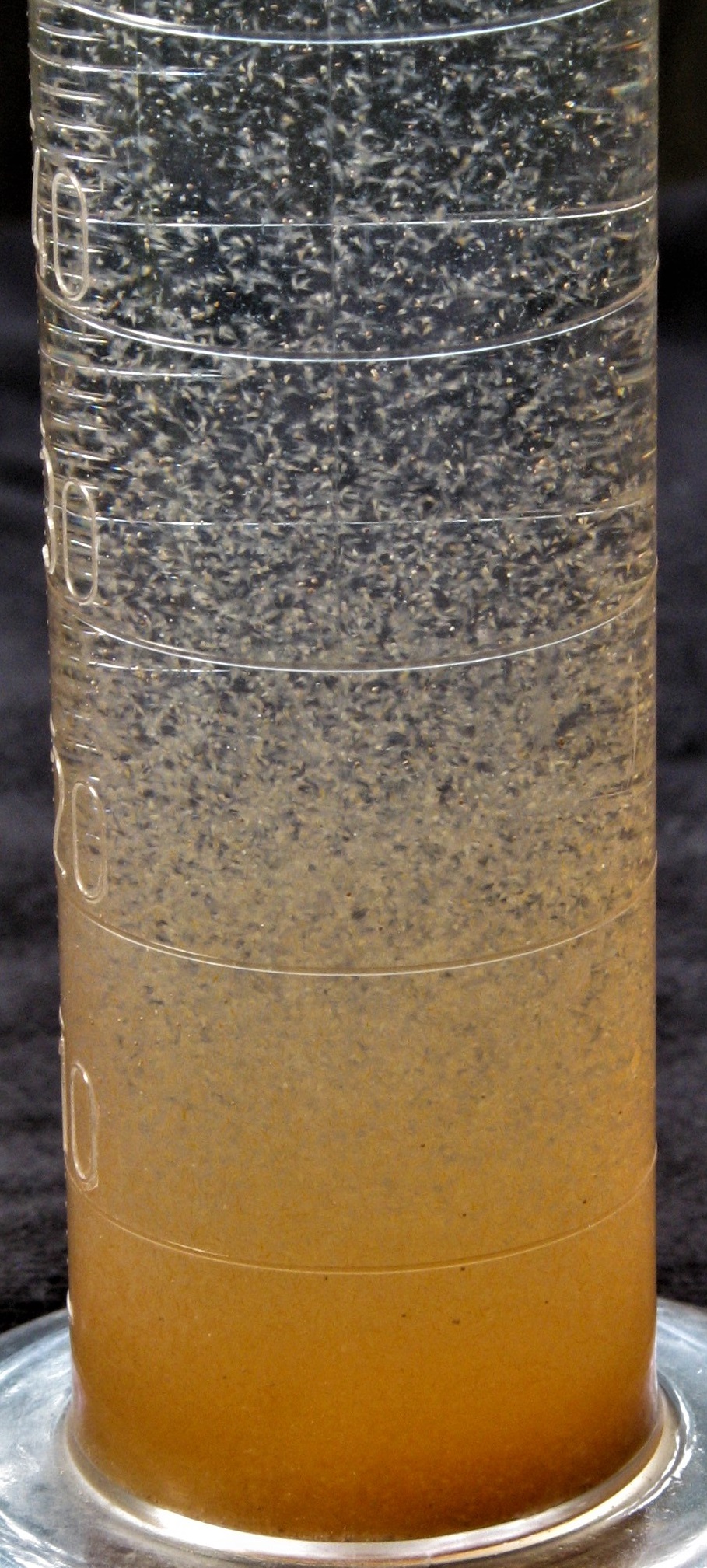
Hatching and Growing Brine Shrimp (Artemia) (Brine Shrimp / Artemia) ist – glaube ich – der ultimative Artemia-Artikel für Aquarienliebhaber. Beginnt mit Bruteiern in einer Suppenschüssel ohne Belüftung. Wechselt zu „Brutgeschirr“, das Nauplien automatisch von Muscheln trennt und das Ernten frischer Nauplien unglaublich einfach macht. Weitere neue Themen sind die Kühllagerung geernteter Nauplien, die Fütterung von entkapselten Eiern für Fische, die Frage, warum ein niedrigerer Salzgehalt am besten funktioniert, und das 3-tägige Züchten von Garnelen.
Der Autor diskutiert die vielen Faktoren (Osmoregulation, Eisenernährung, Empfindlichkeit gegenüber Schwermetallen usw.), die den Schlupferfolg beeinflussen.
Ich nutze seit Juli 2020 die „Deep Soil Methode„. Ich mixe diese mit der „Walstad Dirted Tank“ Methode, bei der ich entweder Torf oder ungedüngte Blumenerde in der Mitte des Substrat beimenge.
Was benötigt man? – Ein Aquarium ab 120 Liter – mindestens 8cm Quarz- oder Spielsand aus dem Baumarkt – mindestens 1cm Torf oder Blumenerde in der Mitte der Substratschicht – viele schnellwachsende Pflanzen (Vallisneria, Cabomba, Hornkraut, Tigerlotus etc.) – Zeitschaltuhr für Beleuchtungszeit um die 10 Stunden – kleine Pumpe z.B. AquaEl Micro, welche mit der Zeitschaltuhr läuft.
Die Vorteile liegen auf der Hand und sind nun bei meine vielen unterschiedlich grossen Aquarien klar sichtbar. Auch habe ich in der Zeit ein paar Mitstreiter überzeugen könnem, die ebenso glücklich mit der „Deep Soil Walstad“ Methode sind. Je tiefer und feiner sich die Wurzeln entwickeln können, umso stärker und gesünder wachsen die Pflanzen. Algen haben so fast gar keine Chance. Ich setze auch gezielt Schnecken und Amano Garnelen ein. Diese fungieren als Putztrupp und halten das Becken Abfall-frei. Die DeepSoilWalstad Methode hat aber noch einen ganz grossen Vorteil: Man kann auf Wasserwechsel verzichten! Und man benötigt keine Filter! Aber Achtung! Die Methode funktioniert ab eine Tankgrösse von ca. 120 Liter!
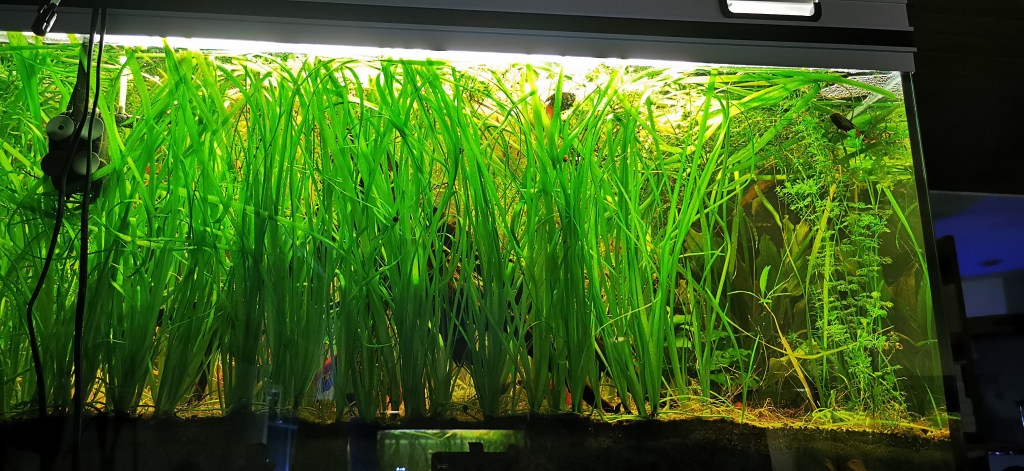
Die zugewucherte Rückseite des 240 Litre „DeepSoilTank“. Links die kleine Pumpe und rechts ein brütendes Paradiesfisch Paar.
Angefangen hat alles im Juli 2020. Ich besorgte mir ein 54 Liter Aquarium und richtete es mit Spielesand und Torf ein. Es bekam viele verschiedene Pflanzen. Darunter Vallisneria und Hydrophila Odora, die bald aus dem Becken wuchs. Ausserdem stellte ich es ans Fenster meiner Küche – und zwar Aussen auf das Fensterbrett. Ein Heizstab sorgte dafür, dass die Wassertemperatur nicht unter 18 Grad fiel. Eine kleine Pumpe bewegte das Wasser ein wenig. Kein Filter und kein Wasserwechsel. Es gab viele Zweifler, die meinten ich hätte sofort Algen und das Wasser würde bald kippen.
Als das „KitchenWindowTank“ genannte Projekt entwickelte, gab es einige sehr spezielle Zweifler, die meinten, dass die von mir verwendete Methode nicht mit größeren Becken funktionieren könnte. Daraufhin besorgte ich mir ein gebrauchtes 240 Liter Becken, entsorgt den Eheim Aussen Filter und begann es am 28.08.2020 wieder mit der „Deep Soil Walstad Planted Tank“ Methode einzurichten. Die Beleuchtung und die kleine AquaEl Pumpe werden nachts abgeschaltet über eine Zeitschaltuhr. Keine Düngung und keine CO2. Ich mache auch keine Wasserwechsel. Auch beim kleinen „KitchenWindowTank“ übrigens nicht. Gestern entdeckte ich, dass die Lotus eine Blüte an die Oberfläche schießt. Die drei Pärchen Paradiesfische bauen kontinuierlich Schaumnester und ich musste kleine Breeder Tanks besorgen. Diese laufen nur mit Sand und gar keiner Technik.
Als das „DeepSoilTank“ genannte 240 Liter Becken innerhalb kurzer Zeit zuwucherte, entschloss ich mich mein altes „WhiteSandsTank“ auch auf Deep Soil Walstad umzurüsten. Das war am 10.10.2020. Seit dem habe ich zwei Wasserwechsel gemacht. Das Becken entwickelt sich prächtig und stabil.
Da ich durch die rege Fortpflanzungstätigkeit der Paradiesfische sehr viel Nachwuchs pflege und ich diese nach Grösse separiere, besorgte ich mir noch ein kleines 125 Liter Becken. Ebenso gebraucht. Hier probierte ich aus, ob die DeepSoilWalstad Methode auch mit Split funktioniert. Somit startete am 01.02.2021 das „BlackJuwelTank“ genannte Projekt. Auch hier ist ein kleiner Innemfilter drin, der sich nachts zusammen mit der Beleuchtung abschaltet.
English Translation. Eine der häufigsten Fragen in Foren und in Facebook Gruppen: wie werde ich xyz Algen los! Hier gibt es Hilfe und zwar auf natürliche Art und Weise. Und nicht mit irgendwelche Wundermittelchen aus dem Tierladen.
1. Zuerst muss man sich fragen, warum es überhaupt zu einem sichtbaren Algenbefall im Aquarium gekommen ist. Denn die Algen sind ein Symptom einer Ursache. Und Symptombekämpfung alleine hilft nicht. Man muss die Ursache herausfinden.
Die Ursache ist meist, dass es zu wenig schnellwachsende Pflanzen im Aquarium hat. Dafür sind zu viele Nährstoffe im Becken. Da Algen auch Pflanzen sind, ernähren sie sich auf die gleiche Weise wie Aquarienpflanzen. Und sie sind immer im Aquarium. Egal was man dagegen tut. Algen nutzen Sonne, Wasser und CO2. Die Vermehrung explodiert, wenn die Algen den Dünger – Das Zuviel an Nährstoff (Ammonium und Nitrate) – schneller verarbeiten können, als die vorhandenen Pflanzen.
Somit muss man dafür sorgen, dass Ammonium und Nitrate schnell abgebaut werden. Schnellwachsende Pflanzen sind hier die Lösung. Vallisneria und Hornkraut bieten sich hier an.
2. Schnecken sind die Helfer im Aquarium, wenn es um Algen geht. Was in der Natur draussen in Flüssen und Teichen funktioniert, klappt auch im Aquarium. Speziell in der Einlaufphase, wenn sich die Pflanzen erst an die neue Umgebung eingewöhnen müssen und daher noch keine Nährstoffe verarbeiten können, putzen BlasenSchnecken, PosthornSchnecken und Turmdeckelschnecken alles weg. Die Blasen-und PosthornSchnecken kümmern sich um Algen und tote Pflanzenteile oberirdisch. Und die Turmdeckelschnecken kümmern sich um alle Algen und Abfälle im Sand. Die Anzahl der Schnecken ist direkt abhängig zum Futterangebot. Schnecken lieben nämlich auch alle Arten von Fischfutter. Wird den Fischen mehr Futter zuteil, als sie fressen können, und dieses Zuviel dient den Schnecken dann als Lebensgrundlage, so werden sich die Schnecken immer von der Anzahl so stark vermehren, bis ein Gleichgewicht erreicht ist. Weniger Futter ist hier oft besser. Zudem dient verrottendes Futter im Boden auch noch dem Bakterien- Algenwachstum.
Ergo: Schnecken sind Dein Freund im Aquarium, das Putzteam. Also bitte behalte sie.
3. Amano Garnelen sind die Geheimwaffe gegen Algen. Sie kümmern sich um alles, was nicht ins Aquarium gehört. Algen, Fischfutter, tote Pflanzenteile, tote Lebewesen.
Die erste Methode um alle Arten von Algen loszuwerden: Amano Japonica. Die Amano Garnele ist förmlich süchtig nach Algen. Sie putzt 24h am Tag alles, was sich im Aquarium befindet. Und das ohne Pause. Viele Zwerggarnelen eignen sich ebenso. Solange sie sich nicht selbst als Futter für die restlichen Bewohner eignen.
4. Unter den Fischen ist der Antennenwels der nach meiner Erfahrung beste Algenvernichter. Speziell im jungen Alter putzt er unerlässlich Pflanzenblätter von allen Seiten, Scheiben, Steine und sonstige DekoTeile. Er braucht ein MorkienHolz im Aquarium für seine Verdauung. Das schabt er ab und nutzt die Bestandteile als Ballaststoffe. Das ist wichtig. Wenn man den Antennenwels nicht an Fischfutter gewöhnt und wenig davon anbietet, dann bleibt er ein zuverlässiger Algenvernichter.
5. Siamesische Rüsselbarben sind bei mir bisher auch in jedem Gesellschaftsaquarium drin. Sie sind sehr lebendig und hungrig. Sie schwimmen pausenlos im Aquarium herum und weiden Blätter, Steine und Deko ab. Man kann sie deshalb locker zwei bis fünf Tage alleine lassen. Sie ernähren sich meist vegetarisch. Lieben aber auch lebendiges Futter. Auch hier ist die Putztätigkeit stark abhängig vom zusätzlichen Futter, dass den Bewohnern gegeben wird. Gewöhnt man die Rüsselbarben zu sehr an Flockenfutter, dann dauert es lange, bis sie wieder Algen ansehen.
Die tolle Sache an der „Walstad Planted Tank“ Methode ist, dass man nichts zu tun hat bei der Pflege der Becken, Pflanzen und der Technik. Letztere ist schlicht nur wenig vorhanden. Ab und zu mal die kleinen Schwämme der Pumpen auswaschen. Filter gibt es ja nicht.
Kein wöchentlicher Wasserwechsel, kein Bodengrund-Absaugen – gar nichts zu tun. Nur ab und zu mal die aus den Becken wuchernden Pflanzen ausmisten. Die Vallisnerien sind immer bemüht jeden noch nicht besiedelten Fleck zu besetzen. Möchte man nun seinem Hobby frönen – und dazu hat man zwischen Weihnachten und Neujahr genug Zeit (noch dazu bei Corona und grauem Wetter) – dann muss man sich eben ab und zu ein neues Projekt besorgen.
Das am 28.08.2020 gestartete „DeepSoilTank“ Becken nach dem Entfernen von ein paar Vallisnerien links und rechts und etwas Guadeloup-Nixkraut in der Mitte.
Da meine Paradiesfische im „DeepSoilTank“ am Fließband Nachwuchs generieren, geht mir langsam der Platz in den 12 Liter Becken aus. Ich brauche für die Heranwachsenden Macropoden ein größeres Becken. Dieses 25cm Aquarium habe ich mir bei Daniela besorgt.
So sieht das neue kleine 25 Liter Becken fertig eingerichtet aus.
Nachdem ich ein paar Pflanzen aus dem „DeepSoilTank“ herausgenommen hatte, fing ich mit dem „Projekt“ an. Was braucht es?
Ein 25 Liter Aquarium
2 cm Blumenerde
5 cm gewaschenen Spielesand
Ein paar schnellwachsende Pflanzen
Etwas Wasser
Ein LED Licht
Ein paar Schnecken
Im Video könnt Ihr die Entstehung mitverfolgen. Das 25 Liter Walstad Becken steht von Venyl LPS eingerahmt in einem Kallax Regal neben dem 250 Liter „WhiteSandsTank“. In 10 Tagen können die jungen Paradiesfische einziehen.


 Veröffentlicht von PeterPan